When one thinks of Himachal, conjured are images of snow-capped Himalayan peaks, vacation favourites like Shimla and Manali, the other-worldly Spiti Valley, the hippie town of Dharamkot, and the Tibetan outpost of McLeodganj. Few realize that tucked away in the same state, perched at roughly 2,500 feet, are the epic Masrur Rock Temples—monolithic marvels that have survived over 1,200 years of earthquakes and landslides. Their quiet, offbeat location keeps them off the standard tourist circuit, and if my Tweet is anything to go by, it’s the first time most people had even heard of them, including some locals. By all means, the Masrur temples in Himachal Pradesh should be a must-visit for every traveler.

Since living in Himachal Pradesh for a couple of months, after my volunteering stint at Peepal Farm, the usual idea of a weekend trip has been a hike to a cafe, a waterfall, or a music or spiritual event. But thanks to a group of people, I ended up joining a trip to the Masrur temples and as an Indian history and architecture nerd, having my mind blown.
Even though I’ve been to the Hindu temple ruins of Angkor Wat on my one week trip in Cambodia and the 14thh century temple ruins in Hampi, finding well-preserved, 1,200-year-old rock-cut ruins tucked into the Kangra hills felt surreal. I say “ruins” because while the complex remained largely untouched by medieval invasions in the plains, it suffered catastrophic damage during the devastating 1905 Kangra earthquake.
History of the Masrur Temples
Unfortunately, despite historians’ best attempts, most of what is known about the temples is approximation and estimates. Known to have been built around the 8th century — almost 1200 years ago — due to their resemblance to the “Gupta style of architecture” from the same period. The temples are a “version of North Indian Nagara architecture style, dedicated to Shiva, Vishnu, Devi and Saura traditions of Hinduism.
The complex was brought to wider archaeological attention by British officer Henry Shuttleworth in 1913 (followed by an Archaeological Survey of India survey in 1915). While its tucked-away location in the lower Himalayas helped shield it from the turmoil of the northern plains, nature was less forgiving: the 1905 earthquake shattered several of the monolithic shrines, giving the complex its dramatic, weathered silhouette today.
How to get to Masrur temples
Located about 36 kms away from Dharamshala in the Kangra district of Himachal Pradesh in a remote area called ‘Lunj’, the temples are best visited by a private vehicle. However, Government HRTC and private buses run along the nearby Dharamshala–Nagrota Surian and Kangra–Ranital routes, leaving a ~2 km walk or short local cab ride to the temple.
It is roughly a 1.5- to 2-hour drive from Dharamshala (and a bit longer from McLeodganj) through the undulating, lower-elevation landscapes of western Himachal. We started from Dharamkot, stopped en route at the ancient Aganjhar Mahadev temple and nearby waterfalls for a langar lunch, and then made our way toward Masrur—losing our way a couple of times in the process.
While the first stretch winds through agricultural plains, the final hour takes you through rolling, pine-lined hills, making the drive almost as good as the destination itself. (Just avoid going in the peak heat of May and June!)
What to do inside Masrur temples?
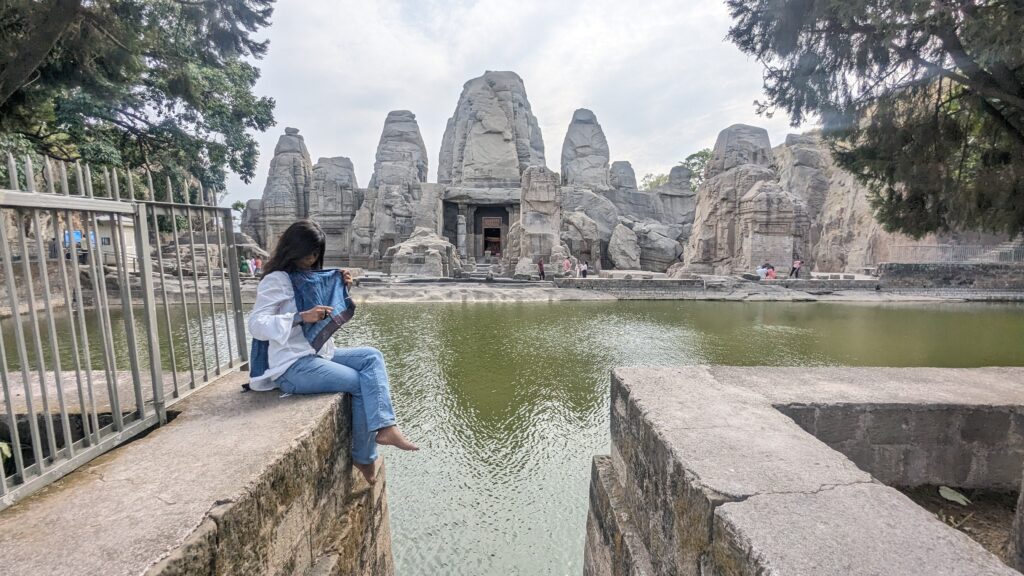
One can easily spend 2-3 hours inside the temple. As you enter, first take a good look at the temples from across the emerald “sacred pond” that give the rocky and sandy appearance of the temples a contrast and makes them even appear more glorious. You can get some photos clicked at the 3-step staircase in the middle of the pond which looks straight to the temples.
An online-only entry ticket
Rather interestingly, the entrance ticket to the temple is only online through a QR-code that leads one to the Archaeological Survey of India (ASI) website where you fill up your details, pay online the 20 rupees and get an instant ticket on your phone!
The ticket allows you entry inside to admire the temple complex from close quarters as well as visit the functional shrine dedicated to Lord Ram, Sita and Laxman.
Even though parts of the exterior facades have weathered over the centuries, you can still spot intricate carvings and relief work throughout. On one section of the rock face, there’s a fascinating vertical layout of three serene, Buddha-like faces carved deep into the stone—each one fainter than the one below it, making you wonder whether the artisans were interrupted mid-work or if centuries of erosion wore them down.
A few inner chambers are closed to visitors, but you can roam freely around the exterior to take in different angles. A rough flight of rock-cut steps leads up to an upper terrace that gives you a top-down view of the shrines, making them look like a cluster of jagged boulders—which, carved straight out of a single monolithic sandstone ridge, they essentially are. In style and ambition, they’re reminiscent of the rock-cut caves of Badami, though even older than the famous 14th- to 16th-century temple ruins of Hampi.


There is also a little dhaba inside the temple compounds that serves freshly squeezed sugarcane juice, samosa, chai, and chole-naan at incredibly cheap prices. Make sure to give them your business as the establishment exists only to serve the visitors of the temple.
When is the best time to go to Masur temples?
The temples would make a great one-day trip during any season, except for the peak heat of May. Each season presents a different look. On a weekday, we found the temple pretty empty save for a few local devotees and weekend travelers.
If you have the time, try to be there around sunset time as the orange-pink hues during the sunset cast a stunning background to the grey-beige temples, making them look almost like a painting! (Unfortunately my camera was dead by this time so no pictures and you just have to visit and find out for yourself.)
Visit these temples if you’re anywhere near Dharamshala; they are one of the most extraordinary—and underrated—relics of Indian rock-cut architecture still standing.