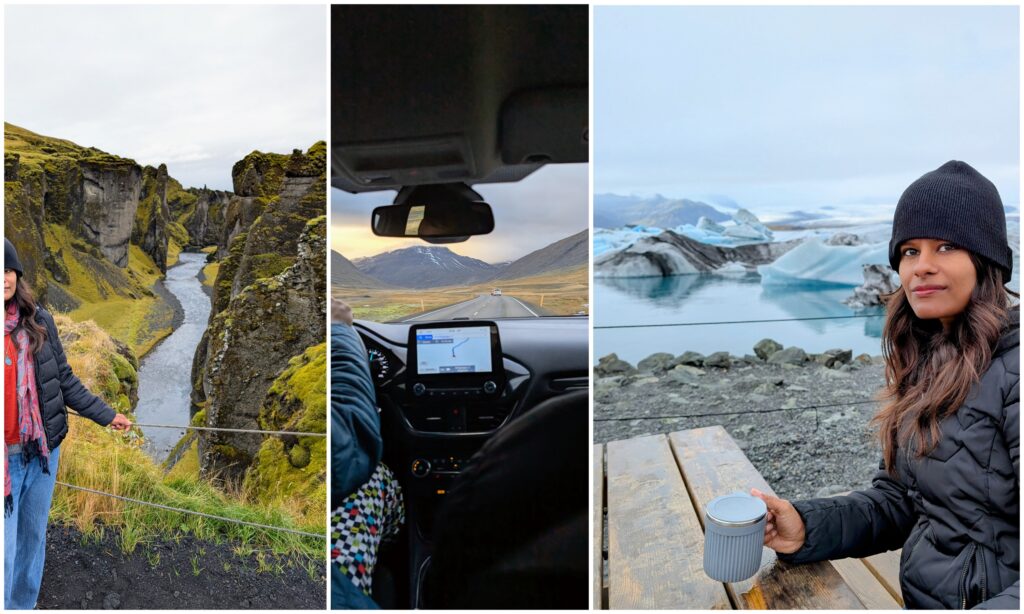
There comes a point in a traveller’s life when it’s time to shake things up. After backpacking through 42 countries over the last fifteen years, I wanted to take it to the next level. And nothing says next level like traveling to one of the most remote, most beautiful and most expensive countries on earth.
They said 2025 would be the year of the Northern Lights, the year the sky would finally stop playing hard to get and dance in neon green. So Iceland it was. What began as a casual chat between a friend and me about chasing the aurora borealis turned into a once-in-a-lifetime trip, and at a fraction of what everyone warned us it would cost in the most expensive country in the world.
Is it really possible to drive the Iceland Ring Road in seven days AND for under $1,000? Most people will tell you no. Heck yeah! Not only is it doable, I’m going to detail out my entire Iceland itinerary so you can pick up what’s useful.
The trip that almost didn’t happen because of a rejected Schengen visa
Since Iceland was going to be the focus and the longest leg of this multi-country Nordic trip, we applied for a Schengen visa from the Iceland embassy. While I got my duly visa-stickered passport within a couple of weeks, both my travel partners for the trip had theirs rejected! The Iceland embassy, it turns out, is strict, and the culprit was a discrepancy in a hotel booking.
With just two weeks to our pre-booked flights, panic set in. While those two reapplied and waited, I began looking for backup company in case the worst happened. That search, on a Facebook group, turned out to be one of the best things that happened to the trip. S, a gentleman on a break from his teaching career at a school in New Zealand, was on a world tour of sorts and happily agreed to join us. In the end, both visas came through on the second try, and off we went: me, the two guys, and the one stranger who would meet us directly in Iceland.
One week in Iceland, through unbelievable beauty, unpronounceable names
After a soft launch of seven days in Sweden, Denmark and Norway (written up in the link above), the stage was set. We flew from Oslo to Reykjavik on a $25 SAS flight, booked three months out. Mine was the cheapest, no-frills fare.
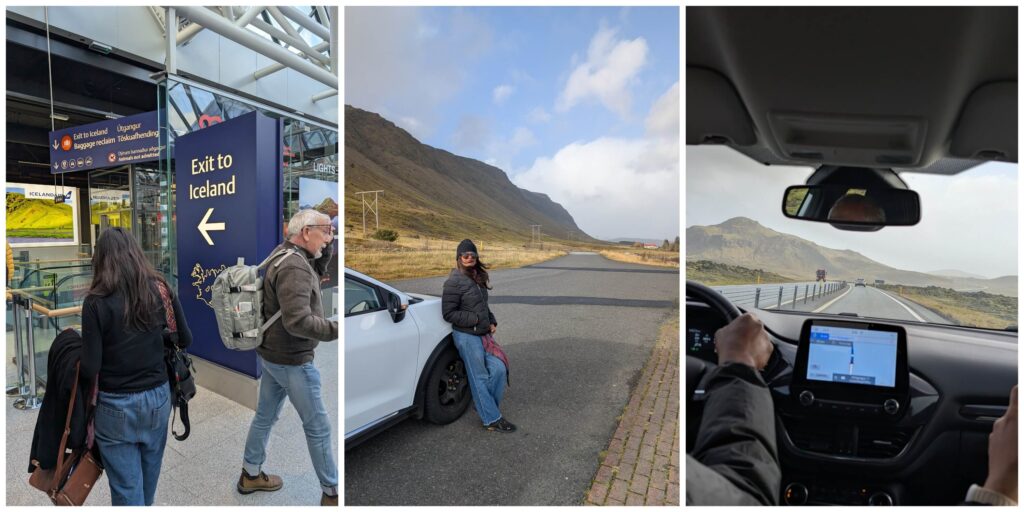
Going from orderly, well-mannered Scandinavia straight into the wild, untamed nature of Iceland was a heady transition! “Exit to Iceland” announced dramatically a sign at the arrivals hall at Keflavik, the country’s main international airport, an hour or so from Reykjavik.
A small rental car, 4 adults, and the beginning of the epic one-week long drive on the ring road
Unlike our flight, instead of months or weeks before, we’d booked a rental car just a couple of hours earlier at the Oslo airport. The staff of Saga, the rental company, received us at the airport to drive us to their office located close by, and by about 11am we were all set: four travellers, one small sedan, and a GPS that would guide us for the next week.
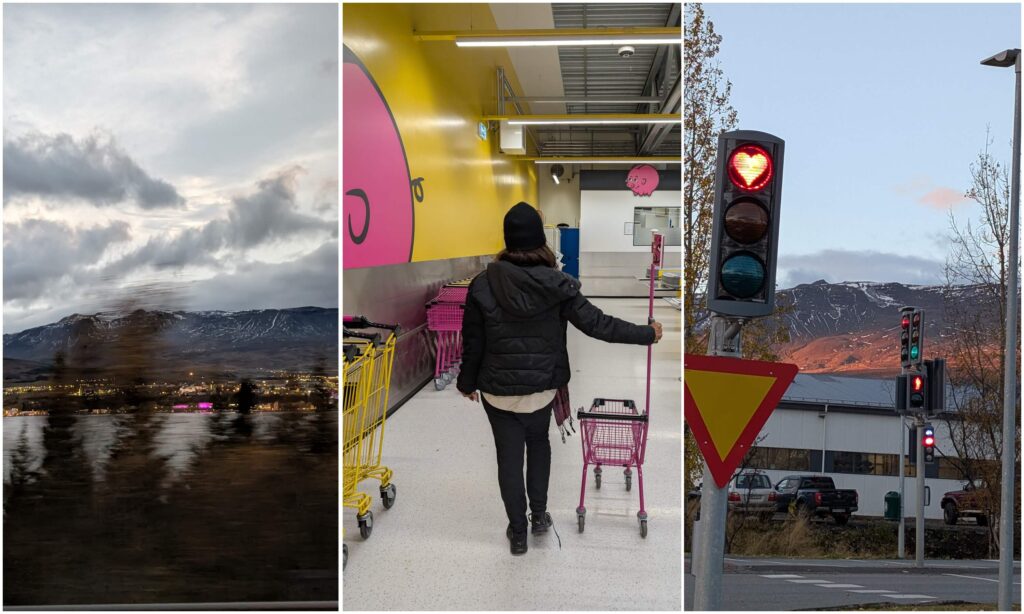
But first, we had to fuel up, the car and ourselves. Having been warned that eating out in Iceland is brutally expensive, we weren’t taking chances. Right next to the rental office we found Netto, a budget supermarket, and it became the first of many grocery-store jaunts that to me, are as much a cultural experience as seeing the Northern Lights. Giant, stocked with things from all over the world, and priced no higher than any ordinary supermarket elsewhere, it turned out to be our saviour. Fruit, bread, instant noodles and a few dips later, we were set for the next couple of days.
The plan was simple. We would begin the ring road the moment we landed and squeeze every hour out of our seven days. We would plan the day’s itinerary on the fly and see whatever fell on the way enroute to the hotel for the night, all along the ring road.
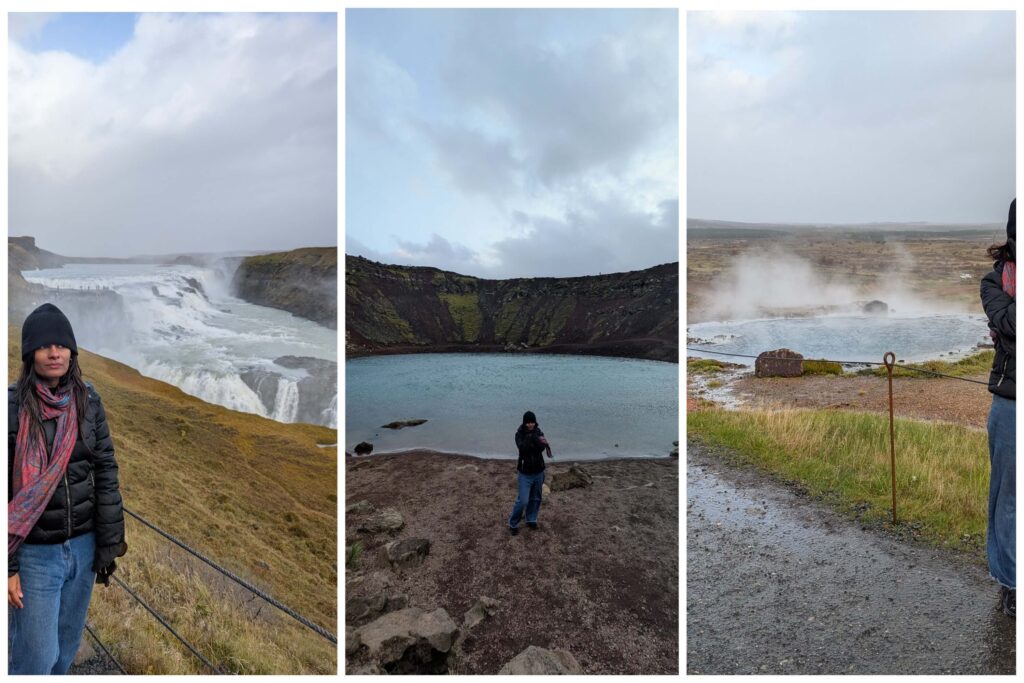
As planned, we bypassed Reykjavik entirely and drove for a couple of hours on roads as smooth as butter, mountains rising on every side, to our very first stop for the trip. The Gullfoss waterfall, vast, thunderous and thick with tourists. First shock of the trip. $11 parking for an hour. (Or upto 24 hours)
And first lesson: In Iceland, what you pay at most sights is the parking fees, not for an entrance ticket per se.
The weather, which had been rainy for the whole previous week, doubled down. We were soaked within an hour of leaving the car, partly from the rain and partly from the mist the falls threw back at us.
We were racing the light, with only a few hours of sun left, so we made a quick stop at the nearby Geysir, a popular stop on Iceland’s golden circle. The geothermal area spread across a wide stretch of volcanic land, littered by small pools of steaming water. One in particular held everyone’s attention. The Strokkur geyser erupted every few minutes and reaching up to 60 feet high, shooting boiling water up in the air, amid much squealing and clapping from the crowd.
The last stop of the day was Kerid, a volcanic crater and a lake, a geological wonder. Tucked almost out of sight and oddly free of the crowds elsewhere, this oval crater, some 300 metres long, looked like a piece of another planet. (Otherworldly would become the word for pretty much everything in Iceland.) Its lake lay turquoise and green beneath the fading sun, a jewel set in rust-red earth.
By the time we were done, the sun had set, and wanting to avoid too much night driving, we drove another hour to our first guesthouse in a small town called Selfoss. A charming villa in the middle of nowhere, it put all four of us in one room. We were exhausted and overstimulated, yet at the back of my mind was the knowledge that we were in the thick of aurora season, and that the trick was to keep checking the sky and the Aurora app I’d downloaded. So I did. I gave up a good, uninterrupted night’s sleep after the previous 24 hours and peeked out of my window again and again. Nothing. Not so soon, the lights seemed to say.
Day 2
A reunion of two continents, otherworldy waterfalls and a drive from heaven
If the previous day had been a hint of waterfalls, today was underlined by them. We left our guesthouse early and started driving toward Vik, planning to see whatever the road offered along the way.
First came a small detour to Þingvellir National Park, a UNESCO World Heritage Site set in a rift valley where the North American and Eurasian tectonic plates are slowly drifting apart. It is also the birthplace of the Alþingi, the world’s oldest surviving parliament, founded in 930. We spent a couple of hours walking there and then continued on our way.
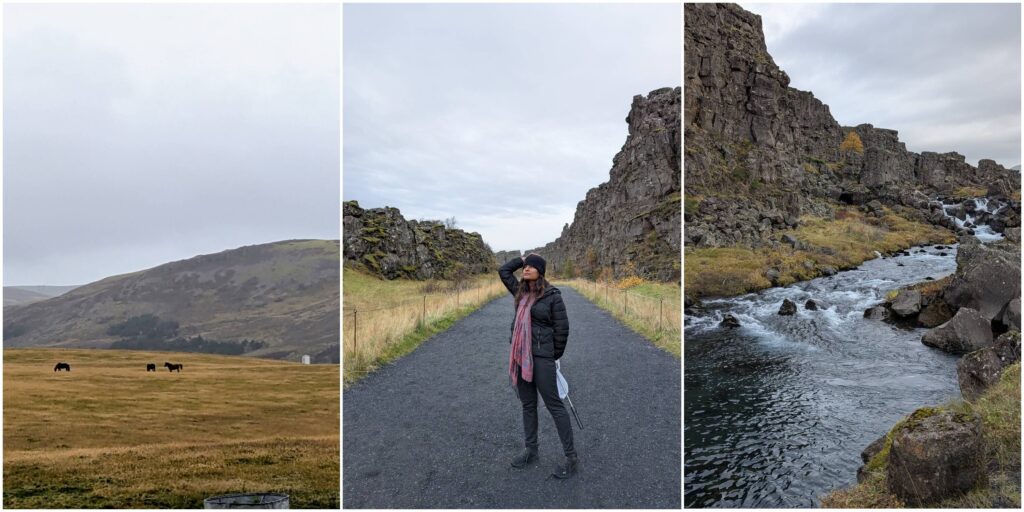
There were four of us, which meant everyone got a window seat, and every window opened onto scenery that unfolded with each mile. Much as we longed to stop at every view, it isn’t as simple as pulling over. Iceland has strict rules about where a car can stop, and parking is allowed only at designated spots or off-road pull-ins. And the rain hadn’t let up, so we enjoyed most of the landscape from the cosy comfort of the car, saving our stops for the day’s first major attraction.
Seljalandsfoss is a 200-foot waterfall, which is impressive on its own, but what makes it a must visit is the little path ‘behind’ its fall. A short walk here takes you to a ridge where you can stand with a roaring torrent of the waterfall inches in front of you. On a sunny day, the contrast of the waterfall in the front against a bright green land around would be surreal, but even now, all black and grey, the waterfall was something else. I wanted to linger on the ridge and savour the feeling, but there was a scramble for photos and reels, and a few minutes was all we got before being herded down.
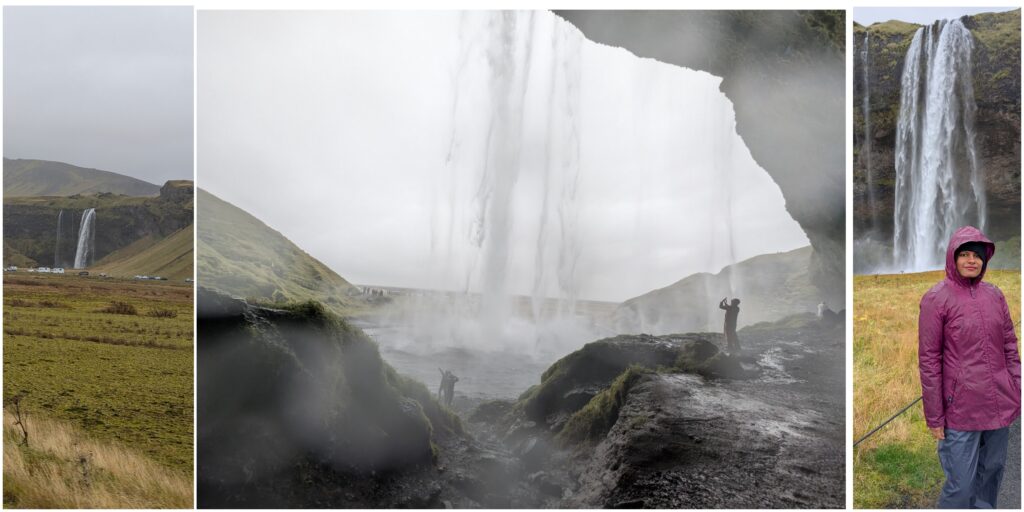
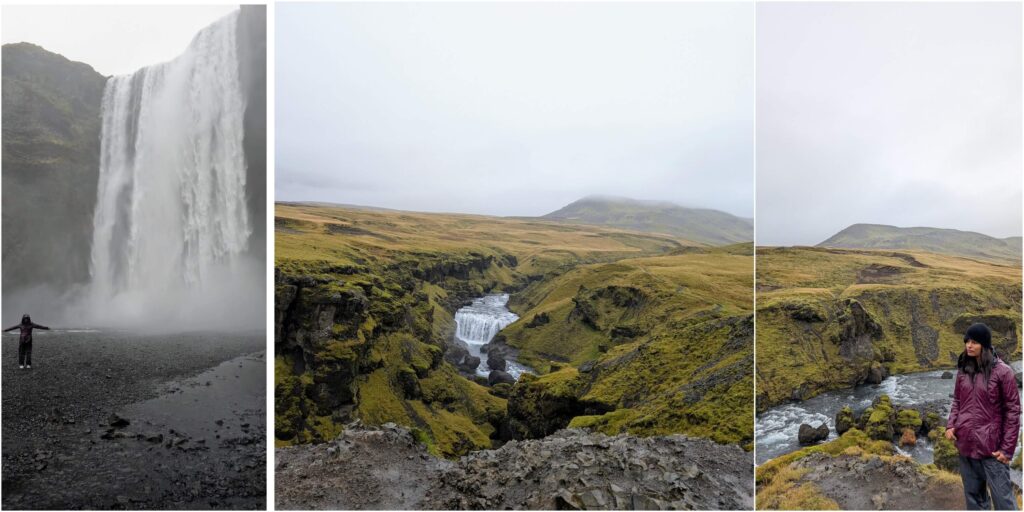
Next was Skógafoss, the waterfall immortalised in Game of Thrones, where a VFX-ed snowy version appears in the iconic dragon-landing scene with Jon Snow and the Khaleesi, and in the Bollywood movie song Gerua where a rainbow cuts through its white, powdery veil. We, of course, were not lucky enough to see one. Instead we braved the rain. Raincoats, rain pants, waterproof shoes and hats, every piece of rain gear we had lugged across Europe, was called into service for this exact moment. The rain came down in sheets and the wind could knock over someone more slender, but still the giant fall was visible through the mist ahead of us.
Beside it, a laddered path climbed the hillside along the stream that feeds the waterfall, a popular trekking route. We walked for an hour on the unpaved trail with views all around: a stream spilling in cascades at varying levels, mossy meadows rolling away in soft green, mountains hazy in the distance. Iceland was every bit as dreamy as they say.
With two of the South Coast’s great waterfalls behind us, and the sky growing darker and colder, we decided to resist stopping elsewhere, and drove straight to Vik.
Vik, a tiny village comprised of at most 500 residents including tourists at any time, is the only ‘major’ town on Iceland’s south coast. Our hotel was charming, cosy and at $250/night, the ‘cheapest’ option for our dates. The three of us shared a room whose window overlooked almost the whole town, and far off we could make out the faint line of the black-sand beach we would visit tomorrow.
The hotel was expensive, but the views from the room, and the kitchen graciously made up for it. Large, well stocked with utensils, and groceries generously left behind by previous guests for the next set to use, and aesthetically designed “warning” posters on every surface. We spent the evening blow-drying our wet clothes and cooking a hearty pasta, the warmth of which is just what this wet, cold, and yet completely satisfying day warranted. We slept right through the Aurora app flashing an orange signal for the Lights tonight!
Day 3
First contact with a glacier, an abadoned plane wreck, and the black sand beach
This was the day I had been looking forward to most: Reynisfjara, the black sand beach. But first, a glacier.
We drove an hour back north toward the Sólheimajökull Glacier (a name we never even bothered pronouncing!). We nearly had it to ourselves, and not only because the morning was young. In another season the glacier would have spilled across the valley in vast sheets of snow and ice; this late in the year it was merely flecked with white. We tottered along an unmarked, rocky path beside the glacial stream, toward the glacier’s mouth, where the ice had hollowed itself into small caves. First contact with ice in the land of Ice. Sólheimajökull may not have been as striking as the glaciers still to come, but it was the first time I had ever stepped inside one, and slivers of blue, laser-bright, pierced the ice like something from a dream.
On the way to Reynisfjara, we decided, on the fly, to check out the abandoned plane wreck that appears on every Iceland itinerary, but it meant a 4-kilometre hike across barren land and I wasn’t feeling up to it in the cold and rain. So I decided to sleep it off in the car while the others went ahead. They were back after a couple of hours and didn’t seem particularly impressed, which made me sadistically happy that I hadn’t gone.
We stopped by a curious sight we passed by along the coast. A large almost square-shaped rock with an arch hole curved over the black beach. Dyrhólaey it was called and offered great views of the South Iceland sea, along with a faint view of Reynisfjara.
A short drive later, we found ourselves in the most crowded spot of our trip so far, the Reynisfjra beach. The place is a tourist magnet, and for good reason.
It isn’t every day you stand on a shoreline of jet-black sand, beside what looked like a ruin of a church of hexagonal basalt columns, with sea stacks jutting out of the water looking like shadowy supernatural creatures of the sea. AI couldn’t conjure up a vision like this!
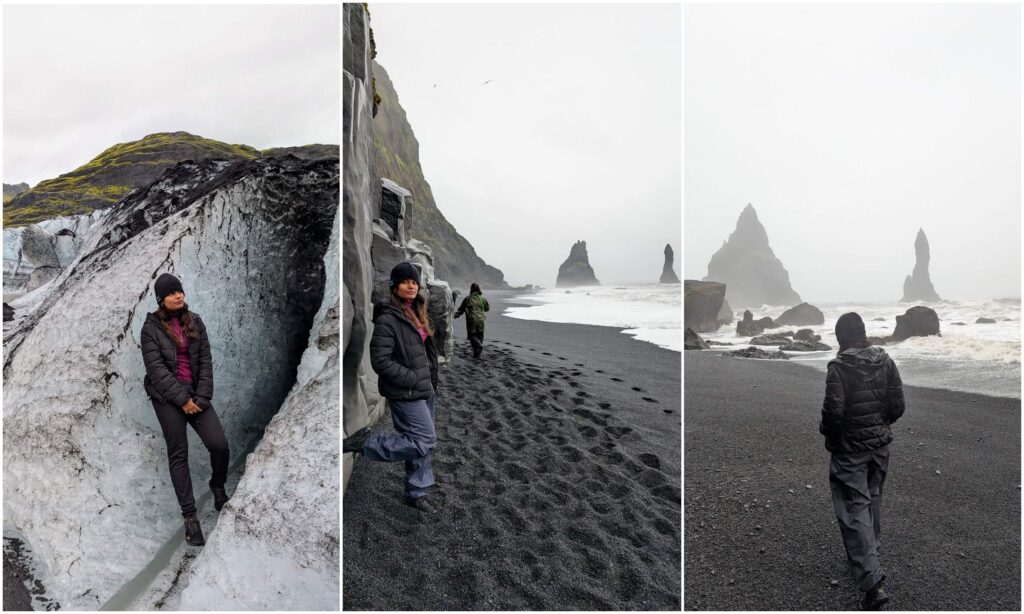
Reynisfjara is as surreal as it is dangerous. There have been drownings here in the past, and Iceland isn’t taking any chances. Warning lights stand at the shoreline: red means no-go, and yellow, which was flashing while we were busy taking pictures, means be careful, because the tide can rise at any moment and swallow the shore. Just as we had wandered further along, the yellow turned red, our signal to bolt.
This was becoming a recurring feature of the trip. We kept arriving at beautiful places and somehow couldn’t linger, whether because of the weather, the lack of time, or the small matter of the place possibly killing us.
I scooped up a fistful of black sand and a couple of rocks for a souvenir (which now sits in a terrarium back at my place), cast one long last look at this black-and-grey surrealist painting spread out before me, and climbed into the comforting warmth of the car. The weather was worse for wear and the others were tired from their long hike, so for a change we decided to take it easy and returned to the hotel in the late afternoon. The snacks we’d carried from home set the tone for a dreamy noon – chai and poha, that classic Indian combination for this kind of weather, enjoyed from our window, with the Icelandic flag whipping in full glory outside. Globalisation, at its finest.
We slept the night at Vik, the first in this trip that we’d spent two consecutive nights in the same place.
Day 4
A day in otherworld: Sea of moss, Yoda, dreamy canyon and diamonds on a beach
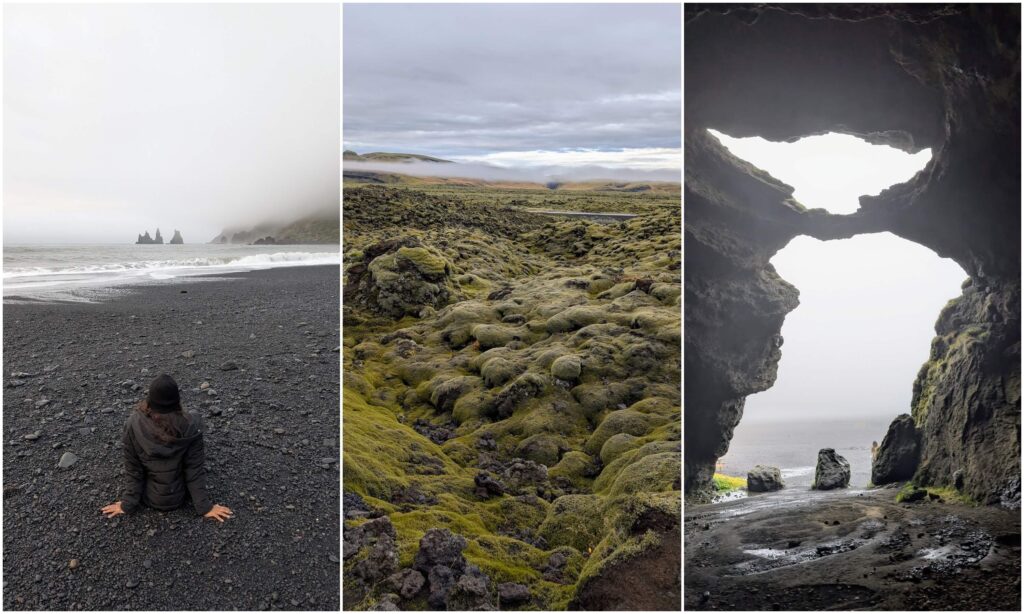
We spent a little more time at Víkurfjara, another black sand beach, along the coast within Vik, but less crowded than the Reynisfjara, and offering the same views of the black sea stacks jutting out of the sea. The gleaming arctic sea against the dark sand was a study in contrasts, silver on black, light on shadow. We bid goodbye to Vik, casting a long long at the iconic church that sits at the top of the ridge of Vik, and topping up our groceries at Vik’s Bonus.
Our first stop of the morning was the Yoda Cave, officially Gígjagjá, tucked away deep into a seemingly unremarkable land by Icelandic standards. Stand inside and look back at the entrance, and its outline is indeed the silhouette of the Star Wars Jedi master, an amusing photo op, if nothing else!
A short drive later, we stopped, unplanned but completely worth the $11 parking fee, at the Eldhraun lava field. Unlike its name, it was less lava and more a planet of green: an unending, undulating stretch of the most velvety moss, looking like earth pimples! We marvelled at the otherworldly sight from the safety of the marked wooden steps, since walking on these delicate mossy growths is strictly prohibited.
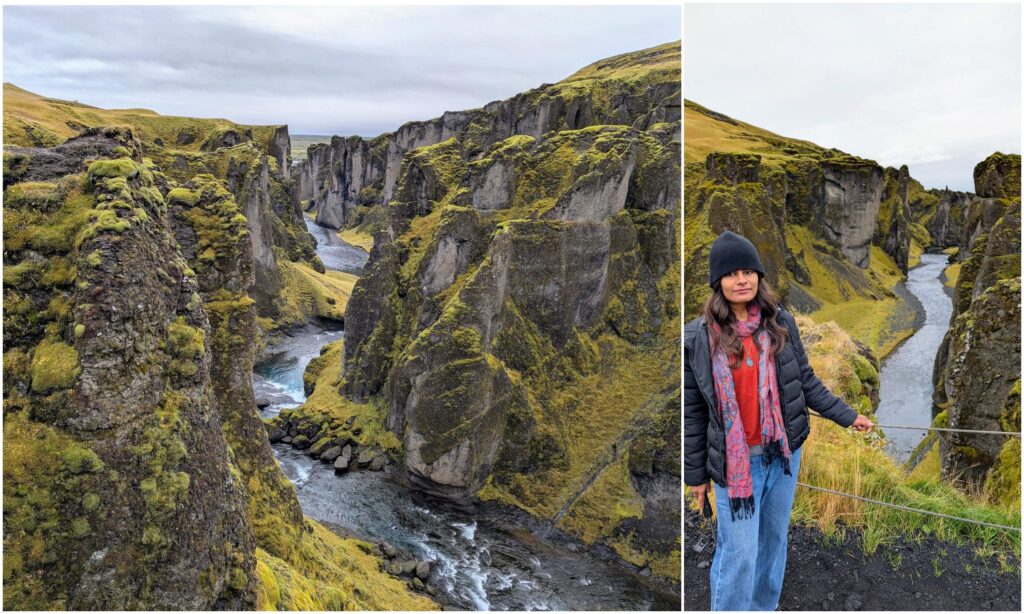
Our next stop was one I had only just learnt about in the car: the Fjaðrárgljúfur canyon. (again, a name we never actually attempted saying.) On a good day, the scenery in Iceland is breathtaking, and today happened to be one: bright and clear, if still not quite sunny. We arrived amid hordes of tourists (including, oddly, a group from one of the IIMs back in India), and it wasn’t hard to see why. Fjaðrárgljúfur is undeniably dramatic. This ancient canyon stretches for about two kilometres, its twisted rock walls rising up to 100 metres on either side of the Fjaðrá river, which winds along the bottom like a ribbon of glass. Several viewpoints along the rim offer sweeping overlooks into the canyon and the land around it.
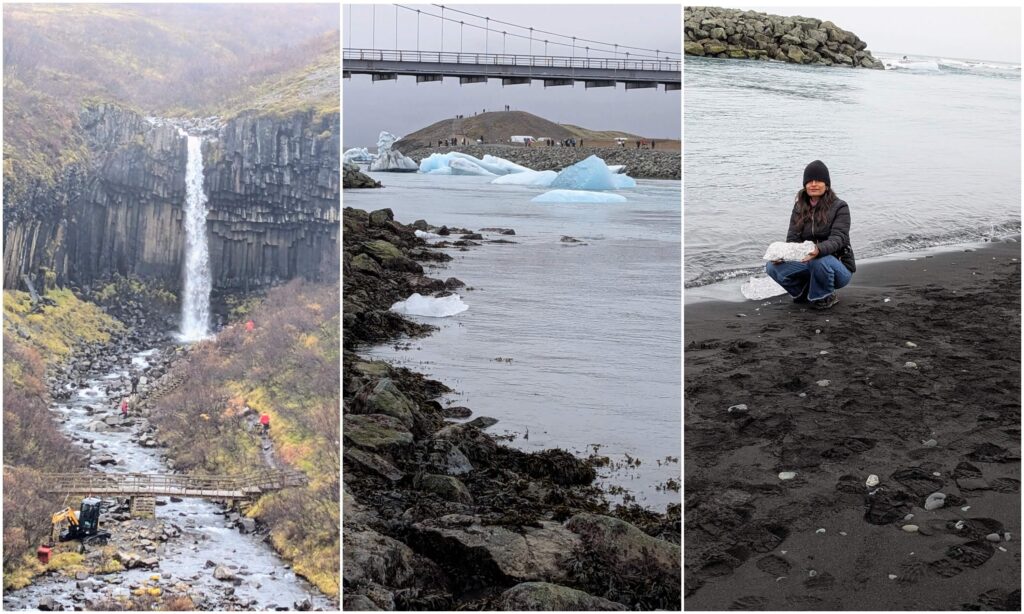
A short drive later, we hiked along a loosely stepped trail to Múlagljúfur, a hidden canyon that shelters two waterfalls, Hangandifoss and Múlafoss. We only went up till the Hangandifoss, as we were already quite late, and in hindsight, this waterfall wasn’t worth losing an hour of the precious daylight. A short drive on led us to Fjallsárlón, an icy lake fed by the great Vatnajökull glacier. We ambled along a sandy, gravelled path around the lake, facing blocks of broken-off glacial ice that gleamed a brilliant blue in the fading light of the day, set against the grey of the water and the rocks all around.
I think this was the first time in the trip I had tears in my eyes. I couldn’t believe that it was possible to witness so much beauty, of so many different forms, in such quick succession until I came to Iceland. And the trip was only about halfway done.
Just as the sun was about to set, we reached the famous Diamond Beach and caught the last light of the day glinting off hundreds of ice shards scattered across the black sand, like jewels spilled by a careless giant. I didn’t have room to be overwhelmed anymore. My mind silently said “Of course”.
We spent the night at Hofn, a small village, at a hostel tucked away in the middle of nowhere, with not another building in sight. I thought being miles from anything resembling civilisation, with no city lights to dim the heavens, would give us our best shot at the Northern Lights yet. I thought wrong. While filling our days with one stunning sight after the other, Iceland refused to show up at nights.
The most epic picnic next to floating blocks of the icy blue Jokulsárlón glacier and a dreamy drive along the coast
Fuelled by a delicious cuppa, courtesy a rare cappuccino machine in our hostel, we drove back toward Jokulsárlón, the glacial lagoon to give the place a proper share of daylight. We had originally planned to take the Katla Ice Cave tour, but at nearly $200 it was prohibitively expensive, and we had heard murmurs that the cave was not in its full icy glory at this time of year, with the snow layer retreating. It didn’t seem worth the money. So we decided to simply spend a couple of hours frolicking at the glacier instead.
The glacier’s mouth fed into the sea, leaving chunks of ice strewn along the shoreline like sleeping whales. And as luck would have it, a rainbow appeared, arching over the whole scene and making for the most perfect photograph. I squealed in delight.
We found a bench and happily plonked ourselves down. Dodging the $15 coffee and the $20 fries — ridiculous prices even for Icelandic standards – from the few food trucks lined up at the parking, our picnic included our packed sandwiches savoured over the view. This trip had been all about rushing toward the next destination, taking cover from the rain, or watching the world through a car window. This was the unrushed moment: calm, rest, a perfectly good weather day under open skies, and a theatre of nature laid out before us.
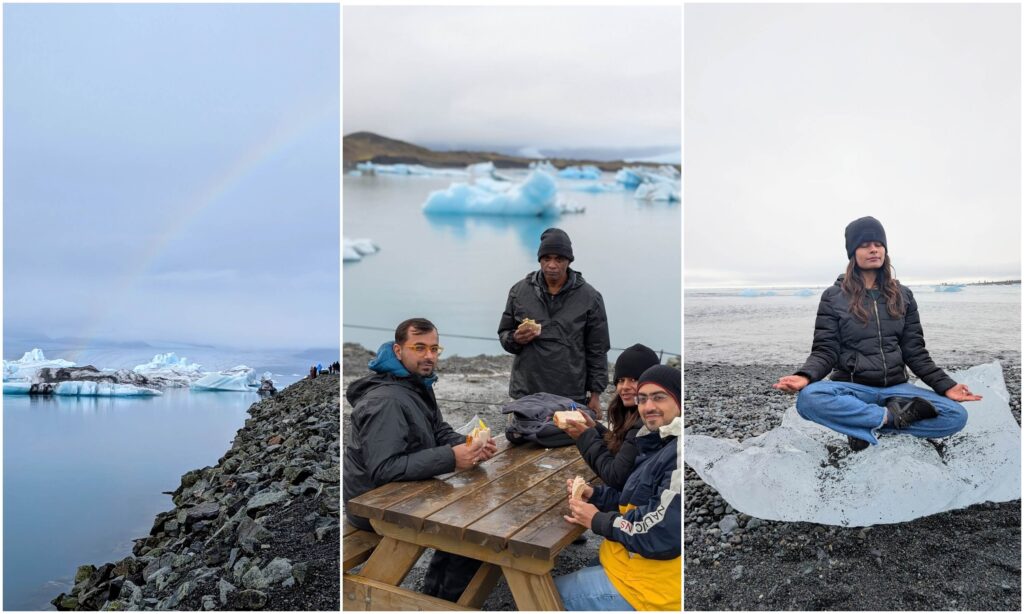
After some light goofing and trying out yoga poses on the large boulders of ice scattered on the diamond beach, we left Jökulsárlón before evening set in, and drove further east toward Egilsstaðir, our stop for the night. The rest of the day was one long drive with little to stop for besides a few photographs. It was also the first day we followed the coast for most of the way, the Arctic sea moving calmly on our right and mossy fields and black, jagged mountains rising on our left. At times the sea lay level with the road; at others it dropped hundreds of feet below a cliff. We passed through several fjords, stopped in Fáskrúðsfjörður, a scenic lil village for a critical fuel refill, then cruised through a 5-kilometre tunnel and emerged in Reyðarfjörður, a beautiful town on the Fjords, before turning inland for the final 30-min night drive to Egilsstaðir, an anomaly on this trip. Our hostel was basic, but with a huge kitchen and a small Bonus nearby, so we stocked up, cooked dinner and called it a night.
But no matter how tired I was, something kept me awake. It was Day 5, we had only two days left, and the Northern Lights were still elusive. I stepped outside several times to catch even a hint of them and found only a completely dark sky. Maybe tomorrow. Maybe the night after.
Day 6
Endless Basalt columns, bubbling mud pots, and a hot spring at dusk
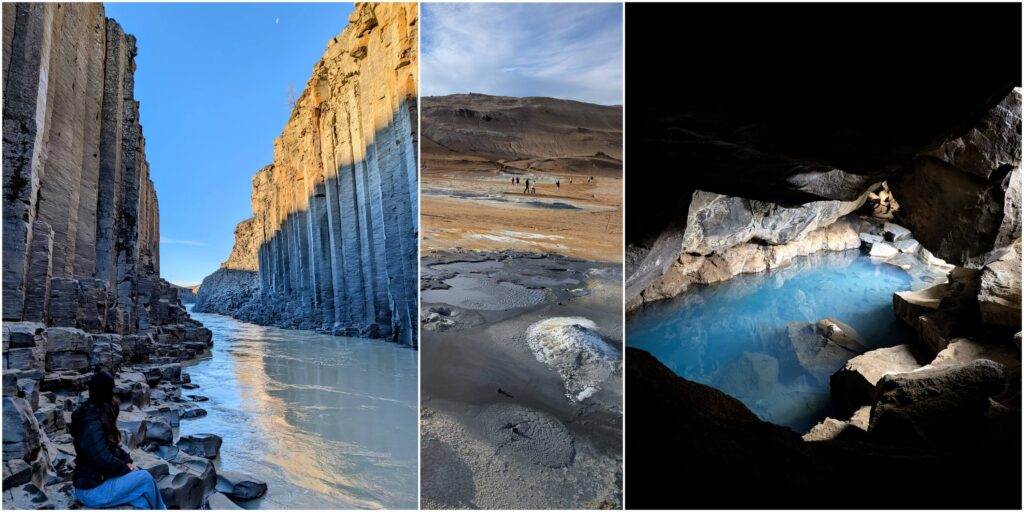
We were now in the innermost parts of Iceland, long past the Golden Circle. The roads were emptier and the sights, if any, quieter. Our goal for the day was Stuðlagil, a lesser-known but stunning canyon deep in the east, lined with basalt columns. Getting there was a bit tricky, but we made it. After parking, it was an hour’s hike down to the columns: thousands of them, flanking a narrow gorge filled with grey, post rain-swollen water. Had we come later in the year, or early the next, the river would have run a luminous blue contrasted against the grey of the columns. Even so, the scenery was otherworldly.
Onwards, we stopped at Hverir, one of Iceland’s most active geothermal areas. A vast, strange park of sulphur springs, where you walk marked trails past mud pots bubbling furiously, their surfaces popping and gurgling like a witch’s cauldron.
We made a quick stop at the Grjótagjá caves, caves with an emerald pool ensconced between two fissures, again famous for having been the filming location inspired the steamy (pun unintended) love-making scene between Jon Snow and the Wilding. Inside the cave, it was barely wide enough to hold one person steady, so obviously, it was impossible to have a couple in the throes of love making and an entire crew in there and the actual scene was filmed in a studio.
After a day of feasting our eyes, it was time to tingle our other senses, with the most famous of Icelandic indulgences: a dip in a hot spring. We skipped the crowd-favourite Blue Lagoon and Sky Lagoon and zeroed in on the lesser-known and much less expensive Mývatn pools. We reluctantly paid the 7,000 ISK ($55~), took the mandatory shower, and slipped into what was essentially an infinity pool: man-made, but filled with the same natural Icelandic spring water, spread over three levels above Lake Mývatn, with a warm section, a hot one and a steaming hot one, depending on your tolerance. None of us took our phones in, so it is probably the only part of the trip we didn’t capture, and maybe that is exactly what we needed. We drifted between temperatures, let the water gushing from a fountain massage our aching shoulders, and fumbled around the floor of the pool for my sunglasses, sacrificed to the Icelandic hot spring. And then, we watched the sun go down over the lake, the mountains turning to silhouettes beyond.
Deeply relaxed, we made the final push toward Akureyri, the second-largest town in Iceland after Reykjavik, in the north. But apparently waterfalls weren’t done with us yet! Instead of plunging from a steep height, Goðafoss spreads wide, like a vast rumpled bed, tumbling in tiers across the land and feeding the lake. It wasn’t the best waterfall by any measure, but by now the sheer variety, scale and backdrops of Iceland’s waterfalls had us spoiled. At some point waterfall fatigue sets in, and what could have been a stunning standalone trip becomes just another part of the scenery.
After Goðafoss came a single long three-hour drive, through the 7-km long Vadlaheidi Tunnel and the only paid tunnel of the trip, which opens into Akureyri, a town that seemed to float on the water, full of charming street lights. Before checking into our hostel, we made one mandatory stop at a Bonus for our last grocery haul of the trip.
Our Akureyri digs were less hostel, and more a boutique hotel with cosy sitting areas, a fire place, art and vintage pieces thrown around, and our room came with a TV, sofa and the most comfortable king size bed! Even though our room slept the four of us, it didn’t feel like a seedy hostel dorm. Well worth the $25/head.
Day 7
Coming full circle, more Game of Thrones, and walking it up in the chic Reykjavik
Today was our last full day in Iceland, and with heavy hearts we began a long drive from Akureyri back to Reykjavik, completing the ring road from north to west. We left around 7am to make it back before sundown, regretting that we didn’t have more time in charming Akureyri.
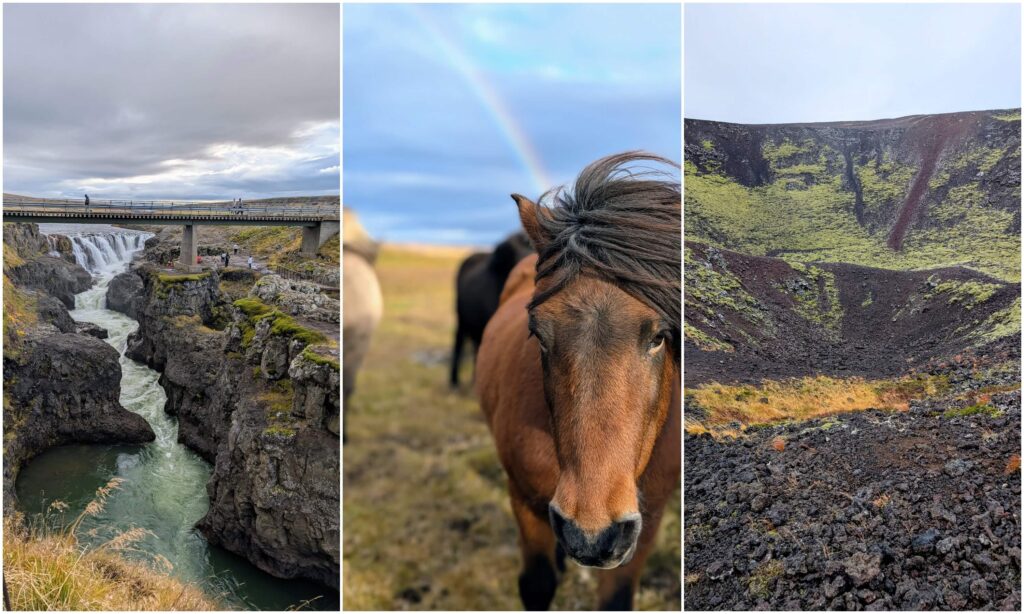
As was the order of the trip, we didn’t have a fixed itinerary or schedule and followed the directions to whatever we researched was worth seeing that day. Turns out there was another canyon called Kolugljufur that was worth checking out. This one was located a few miles off the Ring Road, on a rough gravel road, though not the forbidden F road, and turned out to be worth the quick detour. Kolugljúfur is a small but beautiful canyon, with an equally beautiful waterfall that cascades into several different streams into the canyon below
Seeing all this breathtaking beauty from the comfort of the car had become the norm and new levels had to be unlocked to impress us more at this point. Enter a horse farm. Vast, green, rolling meadows full of famous Icelandic horses strutting around with shiny manes, majestic bearing and absolutely derpy faces. They didn’t shy away from us so we obviously stopped to pet these giant furbabies. The weather was already perfect, and then, a full rainbow appeared out of nowhere. Seven days in, here we were, fussing over horses under a rainbow’s blessing. It was one of those Icelandic moments that make a trip.
Impromptu and met with much grumbling from the other three, we stopped to see something that caught one of our eyes. An easy 30-min hike up took us to the top of the aptly titled ‘Grabrok‘, a volcanic cinder cone, hundreds of feet deep (or high?). From the outside, it looked the flared skirt of a giant! The otherworldly Icelandic landscape simply never did stop giving.
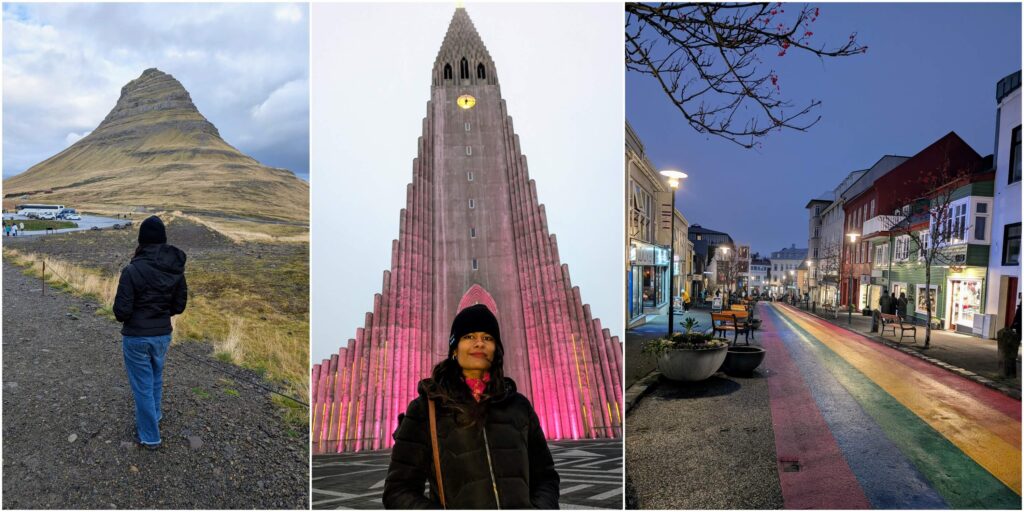
All of us being major Game of Thrones fans, we thought a two-hour detour to Kirkjufell in the Snæfellsnes Peninsula was worthwhile, the mountain famous from one of the scenes. Its near-conical peak, apart from its split-second appearance in the show, wasn’t much of a showstopper. But getting there also took us past the Ytri Tunga beach, best known for seal spotting. But the weather gods played tricks even here. The tides weren’t the right level for a proper seal outing, and only a couple reluctantly appeared for a few minutes, flopped onto the rocks, gazing out at the western sea.
With some Sigur Ros, the Iceland post-rock band aptly blasting on the car stereo, we did the final three-hour stretch and rolled back into Reykjavik around 6pm. The sun was setting, so there was no daylight left to explore the capital. We parked near the striking Hallgrímskirkja church, a new-ish church, whose unique architecture was inspired by the very basalt columns we had seen a day or two before, and the trip had come full circle in more ways than one. We walked the Laugavegur, the colourful main street of Reykjavik town, full of charming cafes and stores, some familiar names, some purely Icelandic. Keeping to our budget low till the very last day, we resisted the urge to walk into a cafe for a sit-down dinner, and contended with some supermarket rolls, a fridge magnet for a souvenir, and checked into our final hostel for our final night in Iceland.
It was also our last shot at seeing the Northern Lights tonight. So after a few hours at the hostel, we set out again and parked at the end of a corniche overlooking the Grotta lighthouse, a spot we had been told was popular for aurora spotting, and waited inside. The rain pelted down. We knew the chances were next to none, but we wanted to give it a fighting shot. An hour in the car, with rain lashing sideways across the windows and the cars around us leaving one by one, sealed it. We left with no Northern Lights.
Day 8
Leaving my new favourite country with eyes and hearts full, despite an unsuccessful chase of the Northern Lights
The next morning, we had breakfast at the hostel, climbed into the car one last time and, instead of plotting the day’s adventure, drove to the rental company to hand back the Ford Fiesta that had been our home for a week and truly stood for the fiesta that Iceland trip was!
The keys were handed over. No damages. That was a win! And for that, we have only our new friend S to thank. I can’t possibly end this travelogue without doffing my hat to the man who drove expertly for seven straight days, never grumbling, never fussing, always following our half-baked, made-up-on-the-spot itineraries. This trip wouldn’t have been the same without him, and to think we had known him all of a week.
I came to Iceland for the Northern Lights and left without a single glimpse of them. And still, what I found instead filled my heart and my eyes far more than any flicker in the night sky could have. A remote land of unpronounceable names became, in seven days, my favourite place on earth. Next time, I want longer, on the Ring Road and off it, and I’ll be greedy enough to ask for two things in the sky: the sun by day, and the Northern Lights by night.
What one week in Iceland cost: The budget breakdown
I’d mentioned how I’d done this entire week in Iceland for less than $1000 per person, a figure almost inconceivable by most who set aside a budget of twice or even thrice that. And i’ll be honest, we did skimp on a few things and yet we compromised neither on experience nor the satisfaction level that a more expensive trip could’ve offered.
| Expense | Per person |
|---|---|
| Hostels, 7 nights | $350 |
| Rental car ($710 split four ways) | $178 |
| Fuel | $100 |
| Groceries | $100 |
| Flight to and from Reykjavik | $60 |
| Myvatn hot springs | $55 |
| Parking at 20 spots | $40 |
| Total | $883 |
Costs are per person, with the car and hostel rooms shared by four. Excludes flights from India and Schengen visa.
Notice there’s no “eating out” line? Believe it or not, we didn’t have a single meal at a cafe or restaurant in our 7 days in Iceland! Partly because it’s so expensive, and partly because we had no time for a sit-down meal on six of our seven days. So breakfast was usually fruits, bread and granola. Lunch was a packed sandwich and dinner was usually a hot meal cooked in the hostel kitchen.
The stays
Here’s the detailed information on every hostel we stayed in, in chronological order.
- Night 1: Hjardabol Hostel, Selfoss
- Nights 2 & 3: Vik Hostel, Vik
- Night 4: Hafnarnes Hostel, Höfn
- Night 5: Lingas Guesthouse Hostel, Egilsstaðir
- Night 6: HI Hostel, Akureyri
- Night 7: Dalur Eco Hostel, Reykjavik
Most of these hostels were amongst the two-three cheapest options available on our dates. Note that the sooner, you book, the more the chances of securing a bed at one of these. Also, it helped that there were four of us. At times, the three or event he four of us shared a room, paying only marginally extra for the extra beds than a full single dorm bed price.
Iceland budget trip tips and hacks
And finally, here’s my curated tips and hacks from this trip and generally from nearly two decades of budget backpacking around the world. Click the arrow button to unravel.
Before you go
- Book your flights early. Ours cost about $25 from Oslo, booked three months out. In Europe, early booking is the biggest cost lever you have.
- Triple-check your visa paperwork. Two of us were rejected over a hotel booking mismatch, and two weeks before departure.
- Three is a company and a great one at that. A road trip is all about optimizing split costs. The car and the hostel rooms are where the money goes, so sharing them is the whole budget trick. Our Facebook-group stranger turned out to be the best find of the trip.
On the road
- Skip Reykjavik at the start. Start the Ring Road straight from the airport and give the loop every hour of daylight you can.
- Plan your days around the sun. Our first day gave us about three hours of light, so keep the big stops for the daytime and avoid driving in the dark.
- Park only where you’re allowed. Iceland is strict about this, and parking cost us about $40 across 20 spots.
- Fuel up when you see a pump. Some stretches, like the long coastal drive on the East coast, offer very little in between.
- Bring real rain gear. Seljalandsfoss is only doable if your jacket, pants, shoes and hat are properly waterproof.
Eating on the cheap
- Hit Netto or Bonus supermarkets whenever you see one. Groceries cost no more than at home, and wandering the aisles is a cultural experience in itself.
- Pick hostels with kitchens. We didn’t eat out once, and the Vik kitchen even came stocked with groceries left behind by earlier guests.
- Pack snacks from home. Chai and poha on a rainy evening beat any restaurant. If you’re vegetarian or vegan, like I am, this is all the more important.
What to skip
- The Katla ice cave tour (about $200). The snow layer was retreating when we went, and Jökulsárlón gives you ice for nothing.
- Blue Lagoon and Sky Lagoon. We chose the quieter Mývatn pools at $55, and sunset over the lake did the rest.
- The abandoned plane in bad weather. It’s a 4 km hike across barren land, and my friends weren’t impressed. I stayed in the car and was smug about it.
- The long hike to Múlagljúfur when daylight is short. In hindsight, it wasn’t worth the two hours.
- Seeing every waterfall. Waterfall fatigue is a thing. Pick your favourites and enjoy them properly.
Stay safe
- Respect the lights at Reynisfjara. Red means no-go, yellow means be careful, and the tide can turn in minutes. Get there before it gets strong.
- Stay on the wooden steps at Eldhraun. Walking on the moss is prohibited, and it’s too fragile to risk.
And the lights?
- Don’t build the whole trip around the aurora. We checked the sky every night and never saw it. Rain and cloud decide, so treat the lights as a bonus.