Despite being practically on India’s doorstep, I never felt the pull to visit Bhutan throughout all my years of travel. Maybe it was the classic habit of taking your own backyard for granted, or simply wondering if the destination offered enough to justify limited vacation days and hard-earned travel savings.
But cut to summer this year when I desperately wanted to travel and no other option seemed forthcoming. Bhutan, the easy country to “check off”, rose to occasion.
At first, the transition is startling. How does a tiny, landlocked nation nestled between giants like India and China feel like an entirely different planet? Walk just a few meters past the border, and the chaotic, littered frenzy of the Indian side gives way to quiet, immaculate, and orderly Bhutanese streets.
Yet in hindsight, I find myself somewhat conflicted about Bhutan as a travel destination.
Let’s be fair: Bhutan is beautiful. It lives up to its reputation as a pristine Himalayan haven, and as an independent nation, its commitment to conservation and community-first development is admirable.
Where it falters, at least for an independent traveler, is the journey itself.
Bhutan: An independent backpacker’s nightmare
At a Sustainable Development Fee (SDF) of $100 USD per person per day for international travelers, it remains one of the world’s priciest destinations. To have backpacked India is a rite of passage; to have visited Bhutan feels like a luxury badge of honor.
For an Indian passport holder however, entering isn’t difficult. No visa is needed, and our daily SDF of ₹1,200 (around $14–$15) is a fraction of the international rate. But how you are permitted to travel once inside changes everything.
Bhutan mandates a licensed guide and a dedicated vehicle for the duration of your stay. Public transit isn’t viable for tourists, and budget backpacker hostels or cheap roadside rooms simply do not exist. With daily government fees, mandatory drivers, and guides ticking away on the meter, slow travel is ruled out. You end up in a race against the clock to justify the daily overheads. For someone who prefers slow travel, impromptu activities, improvised route plans, and getting lost on local buses and had sworn off guided, group trips after my first, Bhutan strips away spontaneity. In its place is a manicured, predictable corridor designed for well-heeled tour groups.
So, this isn’t going to be the usual ’10 Things to Do in Bhutan’ or a structured solo itinerary, the kind of posts you’d typically find on my blog. Instead, it’s a stream-of-consciousness reflection dissecting the Bhutan of marketing lore and familiar tropes, while still appreciating the quiet details of a tiny nation.
The 6-day, guide-led itinerary for a group trip to Bhutan
There is little point in elaborating a detailed day-by-day Bhutan itinerary here because the system forces almost everyone into structured group travel. In my case, it was a 7-day group trip, the operator chosen based purely being one of the cheapest. (comment to know the name)
The group consisted of 30ish travellers, mostly Indians, from around the world. The itinerary was watertight. Meet the team at the Siliguri airport where a 5-hour drive would take us to Jaigao, border town on the Indian side and then a 10-minute walk to Phuntsholing, the Bhutanese border. This is where the first shock hits you as the stark contrast between the dirty, littered and noisy Indian side transforms into a peaceful, clean and organized street just about 30 minutes after immigration formalities.
Next 5 days would be in a loop: Get into the 30-seat tour bus, enjoy the stunning scenary from the comfort of the bus and then make predetermined, timed pitstops at points of interest.
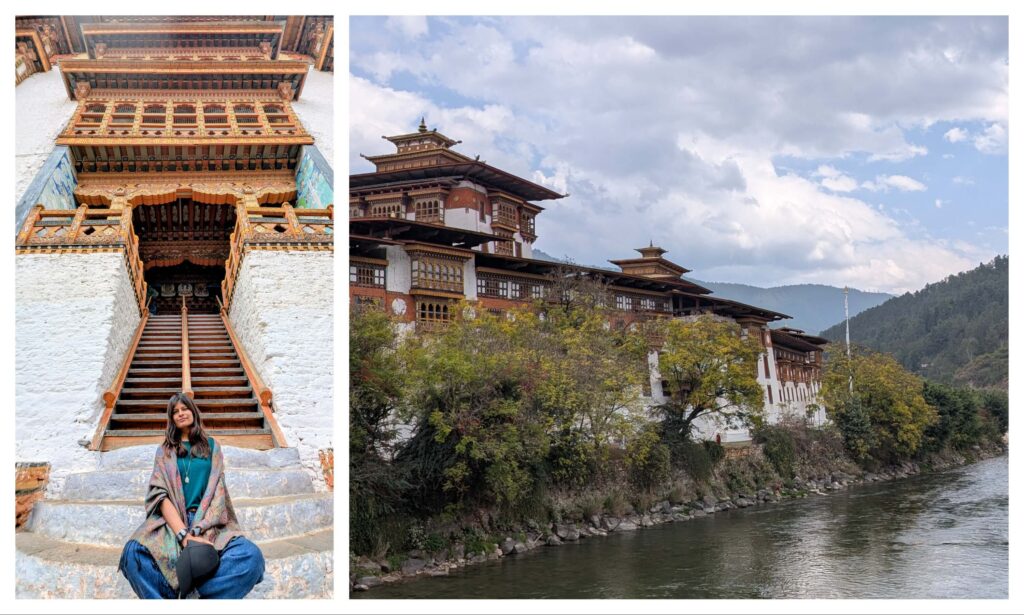
Day one would see us travel from Phuntsholing to Thimphu, the Bhutanese capital, and spending the evening there. Day 2 was taking a day trip to the beautiful Punakha dzong, enroute visiting a curious temple that worships female fertility with some…interesting rituals one of which involves the woman wanting to be blessed circumambulating the temple with a giant wooden phallus! (No pictures allowed so none taken.)
We’d then linger a bit at the Punakha Dzong, a majestic fortress straddling the Po Chu and Mo Chu rivers, and get upsold the the $25 rafting trip on a very demure Mo Chu (which we could for quarter the price back home in Rishikesh), and come back to Thimphu the same night. Then another day sightseeing in Thimphu, including visiting a unique female nunnery, a giant Buddha statue overlooking the Thimphu town and the valley, and then travel another few hours south to Paro, Bhutan’s second biggest city and home to its only airport. On day 5 in Paro, we’d do the hike to the magnificent cliff-perched Tiger’s Monastery, soothe aching limbs with a unique $10 hot stone bath ritual later, and soak in an evening of Bhutanese culture. Young Bhutanese locals improvised a series of dance and song performances, in an attempt to recreate a tshechu (festival) complete with a ‘masked dance’ (cham), for the appreciating tour groups, semi intoxicated on aara – the Bhutanese liquor.
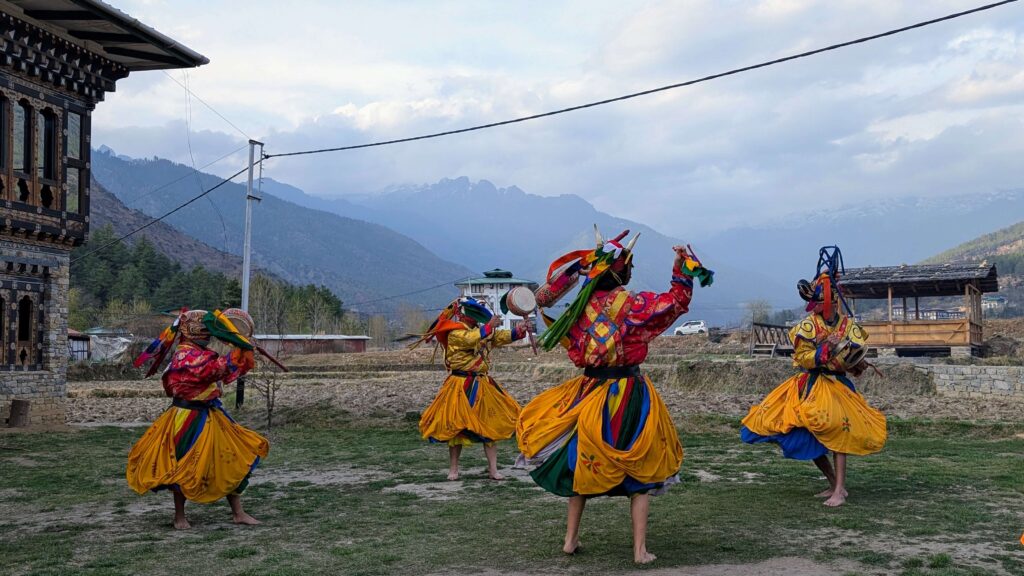
I’d be honest, I thoroughly enjoyed my trip. There was enough to see and fill up the days. As far as tours go, this one checked all the boxes. Not to mention, the adorable tour guide Ugyen (Bhutan 101: Almost every third man is called Ugyen) and our constant companion for the 6 days came with good humour and spirits and kept the group thoroughly engaged. And yet, I couldn’t shake off the feeling that this was a rehearsed act, done week after week, and every historic lesson, was less travel, more script.
The After-Hours Antidote: Bhutan’s Obsessive Karaoke Scene
If daytime Bhutan feels choreographed, the after-hours tell a different story. Bhutan has an intense karaoke culture that nobody really talks about!
Calling out to tourists and locals through neon-LED signs across Phuentsholing, Thimphu and a few in Paro is a slew of karaoke lounges. These aren’t flashy commercial clubs; they’re intimate, carpeted spaces with plush sofas and dim ambient lighting that feel more like someone’s private living room. It is unequivocally the local crowd’s favorite way to wind down after dark.
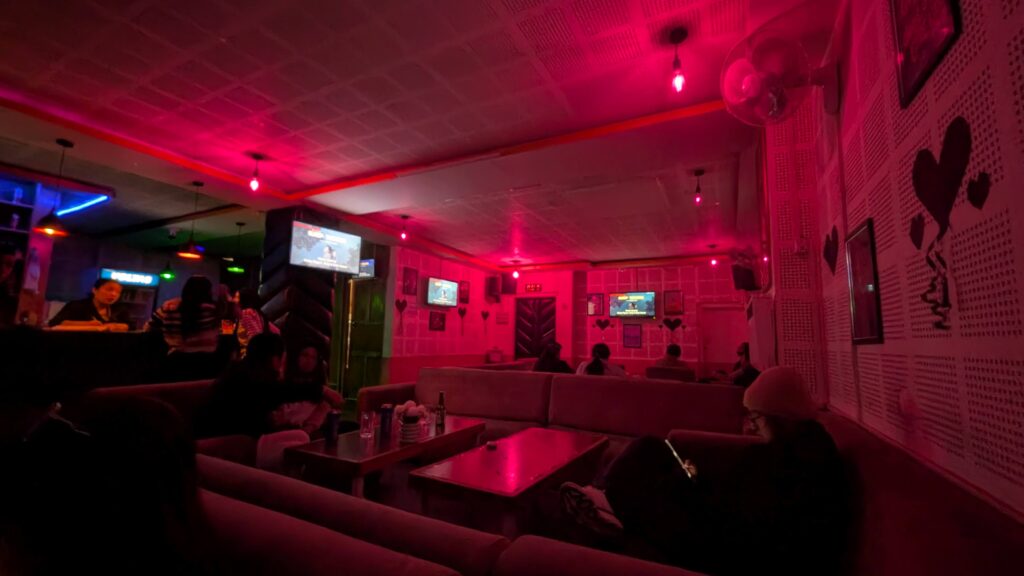
It’s also one of the few places where the invisible wall between tourist and local completely dissolves. On any given weeknight, you’ll find Bhutanese locals and Indian travelers huddled around the same screens, trading the mic between Bhutanese ballads and full-throated 90s Bollywood anthems over mugs of cheap Druk 11000 beer. Easily one of the rare, raw cultural experiences of the entire trip that allowed for a moment of pause amidst the Amazing Race-like pace, and a real chance at interaction with the locals.
What does Bhutan offer that India doesn’t?
Even though Bhutan is a sovereign country, Indian travelers make up over 70% of its visitors, the Bhutanese Ngultrum is pegged 1:1 with the Indian Rupee, and local store shelves are packed with Indian goods.
Sikkim shares an almost identical ecological landscape. The ancient gompas of Spiti and Ladakh rival anything found in the Paro or Punakha valleys. The high peaks of Bhutan remain entirely off-limits to mountaineering out of reverence for local spirits, a cultural choice worth respecting, but one that limits raw thrill of trekking through some of the highest mountains in the world, unlike a Himachal Pradesh or Uttarakhand.
But what Bhutan offers comes at a significant premium. Including domestic flights to get to Siliguri, the cost of the group trip, entrance fees at many of the ‘attractions’, and bare minimum souvenirs, I spent around $500 for the 6 days. If you’re flying directly to Paro, that figure can double. A costlier tour operator and/or another couple of days on the itinerary and costs multiply. A fraction of that money can fund a raw, deeply authentic expedition through comparable Indian landscapes, or an immersive week somewhere else entirely. (For perspective, I did a 10-day Egypt trip for about $700) and just a few months later, a one-week trip through the other-worldly Spiti valley for about $100.
With so much overlap between India and Bhutan landscapes, it naturally raises the question: What does Bhutan offer that India doesn’t and is traveling there worth it?
Bhutan’s clean and cares about the environment
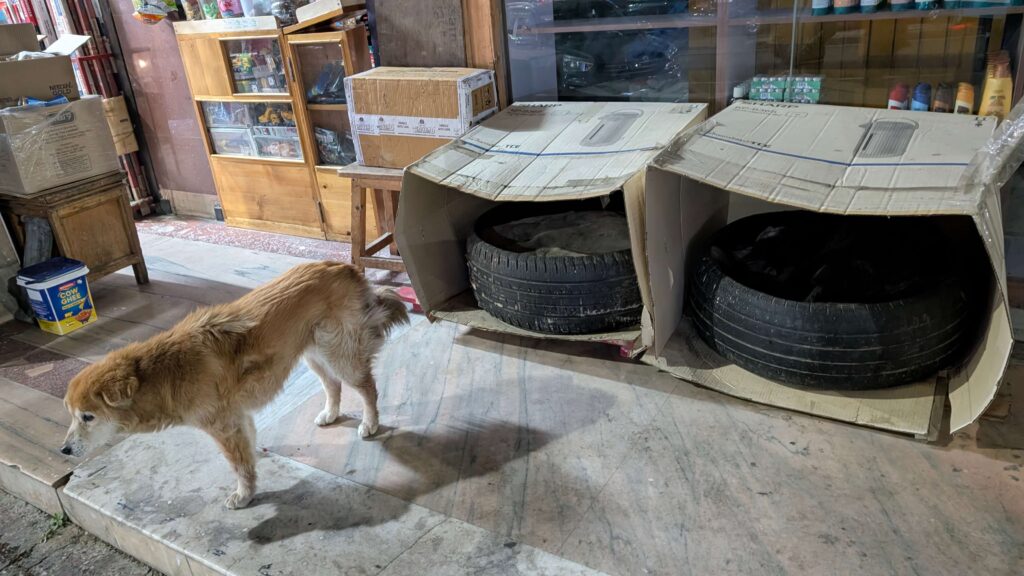
The cleanliness, the order, the structure, thats where Bhutan’s similarities with India end. Littering is almost non existent in Bhutan, except for likely by Indian tourists themselves. Bhutan’s commitment to the environment is embodied in its electric vehicles, including the tour bus we were on, awareness signs highlighting waste management and energy-saving best practices in public spaces, and its humane treatment of its stray dogs amongst others.
Bhutan, a nation of culture
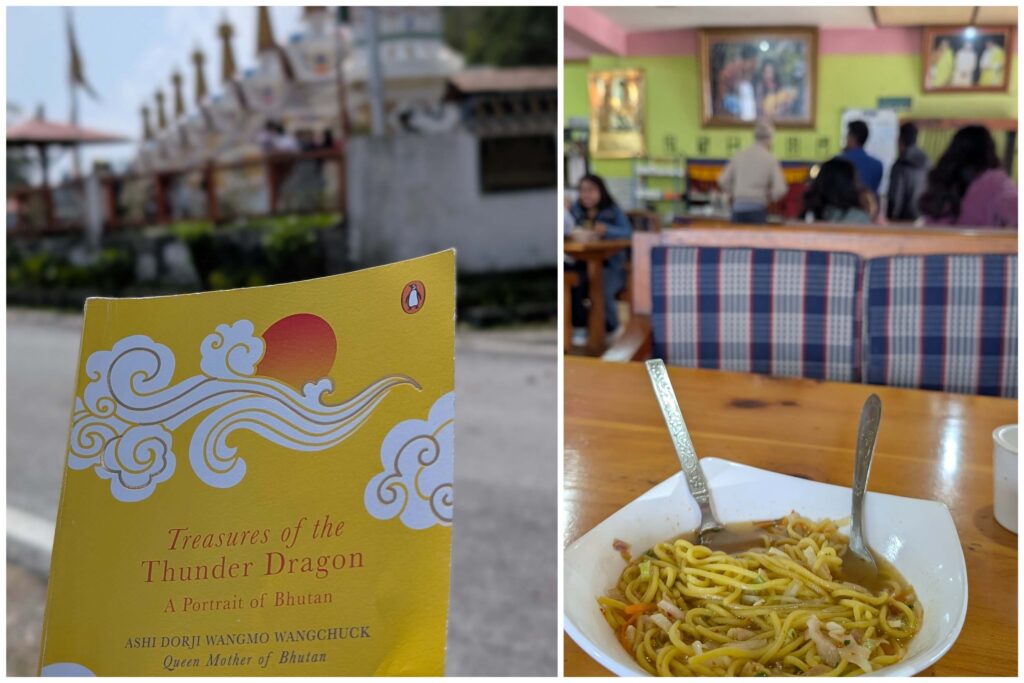
The people in Bhutan are gentler, speak softly, and tend to avoid eye contact or much conversation. Their quiet sophistication and adherence to preserving their culture reflects in their clothing. Men dressed in a draped robe called Zo and women in muted-coloured dresses called Kera outnumber those in Westernised clothing. In fact our last day in Paro included an exercise where the group could hire these ‘costumes’ and pose for photos at the base of the beautiful Rinpung Dzong. I skipped the activity out of respect for the locals.
The benevolent, handsome king and his gorgeous wife are well-educated, sophisticated monarchs and well-liked by the Bhutanese, a fact testified by ubiquitous, framed family portraits put up in almost every establishment, from small roadside eateries to big showrooms.
And the silence! Can we take a minute to appreciate how quiet Bhutan is? Honking is almost non-existent, and strict traffic discipline makes for pin-drop silence on the streets. To my Indian-wired ears, this level of calm in a capital city was a delicious shock.
Gross Happiness Index – A real metric or a glorious gimmick?
Then there is the mythology of Gross National Happiness (GNH). While popular reels claim Bhutan threw out GDP in favor of joy, the reality is far more grounded: Bhutan still measures standard GDP, anchored by hydropower sales to India and cross-border trade. GNH serves as a philosophical framework, but in daily life, the economic strains are visible. With minimal domestic manufacturing, most everyday goods including the “local” souvenirs are imported from India or China. As a result, retail prices are steep, prompting budget-conscious locals to make regular runs to the Indian border where the exact same items cost much less, even after factoring in travel.
While tourism revenue does fund vital public services like free education and healthcare, the romanticized image of an untouched Shangri-La glosses over the reality of a developing nation grappling with severe brain drain. High-paying corporate jobs are scarce, pushing much of Bhutan’s younger generation to look toward India, Southeast Asia, or Australia for work. Standing by the scenic Paro airstrip, we watched elderly parents tirelessly wave their hands and scarves until the planes disappeared from sight, sending their children offshore to earn a living that could sustain the family back home.
Fact check: Is Bhutan really meat free?
Another slightly jarring aspect of Bhutan’s marketing is the much advertised “there’s no commercial slaughterhouses in Bhutan” claim. It’s disingenuous to say that when most of the local cuisine is meat-based. (And you’d be hard pressed to find a vegan dish amidst the cheese-based national dish Ema datshi!) Bhutan imports massive quantities of poultry, pork, and beef directly from West Bengal while touting its no-commercial-slaughter Buddhist ethics. Convenient.
Where Bhutan scores big: Architecture
Yet, there is one area where Bhutan deserves unqualified praise: its architecture and cityscape. To me, the part that struck out the most was Bhutan’s striking architecture and curiously is its least talked-about feature. Governed by traditional architectural standards, rooted in Zorig Chusum, the nation’s historic arts and crafts codes, every building – from a roadside petrol pump to a cafe to a major administrative dzong adheres to specific proportions, ornate wooden cornices, multi-colored lintels, and mythical motifs. Nestled amidst snow-clad Himalayan peaks in the distance and framed by bursts of seasonal cherry blossoms, Thimphu’s small but orderly, ornately-beautiful cityscape makes for an otherworldly sight.
Check out my reel on Bhutan’s architecture here
In summary, go to Bhutan if you absolutely must check off another country or every country in the world. Or if you appreciate an orderly, tranquil low-friction taste of the eastern Himalayas, or if you want to see a small nation stubbornly protect its architectural identity and forest cover. If you have the travel funds and prefer a guided, comfortable holiday where logistics are taken care of end-to-end, it delivers.
Just don’t arrive expecting a wild, open-ended Himalayan adventure. The Bhutanese landscape may be clean and green, but the spirit of discovery stays buried under the guided group trip.

One comment
Bhutan is a perfect example how can a wall divide two different world where one side chaotic, loud, vivid and other side peace, serene, calm with beauty.