
In my previous post, I covered the Giza and Aswan leg of my Solo Egypt trip.
The pyramids alone are a good reason to visit Egypt, but this fascinating country offers a traveller much more than one ancient Wonder of the World.
For the second half of my trip, I started retracing my steps from southern Egypt, moving from Aswan back to Luxor.
Spending 2 days in Luxor: The city of the dead
Luxor is where the dead lie. It’s where the majestic Pharaohs lived, held lavish courts, and built one of the most advanced and enduring civilisations in the world. The Valley of the Kings is where many of them were buried in rock-cut tombs that are still remarkably well preserved, and the land keeps throwing up awe-inspiring archaeological discoveries.
Karnak Temple Complex, Luxor
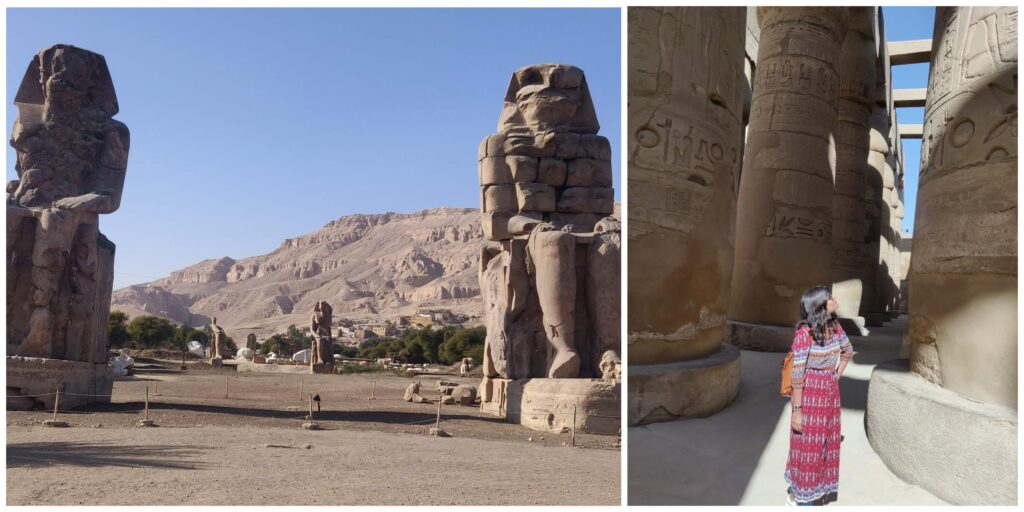
My first stop was the majestic Karnak Temple, a maze of 134 towering papyrus-shaped pillars with fading but impressive frescoes, inscriptions and carvings, along with pylons, obelisks and temples dedicated to various gods. Pharaohs kept adding to the complex over some 2,000 years, and the oldest parts go back about 4,000 years. Only part of Karnak is open to the public, with the rest under excavation and restoration, as most monuments in Egypt usually are. The entrance is lined with rows of ram-headed sphinxes on either side, an intimidating preview of what’s inside.
After a couple of hours at Karnak, I walked to the city centre, a pleasant 2-hour stroll mostly along the Nile. With the sunny weather, cool breeze and crystal blue water, I couldn’t help getting another felucca ride, this time all to myself. The boatman sang me local songs, made me tea and let me spin around on the boat. Ah, the good life! Egypt makes you feel rich.
I spent the evening walking around the main area and hanging out with a local who brought me koshari from a place he knew. He was enamoured by the fact that an Indian girl was in Egypt all by herself. (Maybe it wasn’t very common back then.)

Valley of the Kings (and the queens), Luxor
I set aside a whole day for the Valley of the Kings, since it’s a while away from central Luxor and each site can take an hour or so.
Most travellers go with a tour, and since I was staying in a hostel, it was easy to arrange. I went with 5 people from my hostel and a few others in a 10-person van. I don’t remember exactly, but I think I paid about $50, excluding entry charges at individual sites.

Hatshepsut temple

The first stop was the marvellous Hatshepsut “mortuary” temple, dedicated to Hatshepsut, one of the few female pharaohs, who ruled around 1479 to 1458 BCE (about 3,500 years ago). It’s considered a masterpiece of ancient architecture. Built into the cliffs, it rises over several levels above the beige desert, almost blending in.
Tomb raiding in Luxor
After a quick visit to the temple, we got to the most awaited part of the day: the tombs, still in the form they were excavated in, with their sarcophagi and other funerary paraphernalia.
If you know a little Egyptian history, you know the Egyptians were among the first to build their whole culture around the afterlife. To ensure a comfortable passage, they performed elaborate rituals. One of them, mummification, was reserved mainly for royalty and the upper classes because it took significant resources.
Mummification process
The organs were removed from the body and stored in canopic jars. The body was dried with natron salt and embalmed with oils and spices for long-term preservation, much like a pickle. Then it was wrapped in layers of linen to seal everything in, and the dead person’s possessions were placed alongside. Pets such as dogs, cats and even smaller animals were embalmed the same way.
I knew all this in theory, but nothing prepares you for seeing the tombs in person.
What to expect in Valley of Kings, Luxor?
Most tombs run deep into the earth, so you go down a long flight of steps into a dark, damp cave surrounded by well-preserved murals and carvings. The higher the king’s rank, the more elaborate the art. At the innermost part of the tomb is the sarcophagus, its stone outer shell covered in carvings, which once held the mummy in its coffin.
You won’t see mummies here. Conditions in the tombs aren’t right for preserving them, so they’ve been moved to museums, but you’ll see everything else.

You can also visit the tomb of the famous young king “Tuttenkhamun” at an extra premium charge but we decided to skip it.
Valley of queens and tomb fatigue
After three or four tombs, they all begin to blend in and “tomb fatigue” sets in. I skipped the Valley of the Queens, expecting more of the same. I was later told the queens’ tombs are even more elaborate and lavish, which makes sense, so that was a big miss!
After an intense afternoon among the dead, fending off herds of hawkers and peddlers, we returned to the city. I sat down at a local restaurant and ordered my favourite Egyptian vegetarian staple: koshari.
In the evening, I walked along the Nile and visited the small Mummification Museum, which has animal mummies and other objects found in the tombs.
I ended the day at a popular, high-end restaurant called Safar, where my hostel mate enjoyed freshly roasted pigeon and I lost my appetite. After that I chilled in the hostel’s cafe until it was time to catch my train to Alexandria.
Spending a day in Alexandria, Egypt’s Mumbai
I reached Alexandria around 1 pm. Since I wasn’t staying overnight, I looked for a place to store my luggage at the station and got a shopkeeper to agree to keep it.
Bag-free, I hopped into an all-too-familiar shared van packed with locals, women in abayas and men in galabeyas, and headed to the Qaitbay Citadel at the edge of the corniche. After the heat and sand of Luxor, I found myself in a city on the Mediterranean, in an almost Europe-meets-Orient setting.
The fort had shut by the time I got there (4 pm), so I wandered aimlessly along the beach and ended up at the wonderful Silsila cafe, right on the water with waves almost hitting its walls. The food isn’t anything to write home about, but for views and ambience, it’s one of the best cafes I’ve been to
Bibliotheca Alexandrina
The ultra-modern, disc-shaped Bibliotheca Alexandrina on the shore was built to revive the spirit of the storied ancient Library of Alexandria.
The library is huge and gorgeous, but what struck me was the contrast with the locals I’d met elsewhere on my trip. Here were young, stylish, modern Gen-Z Egyptians huddled over books and chatting in fluent English.
I even found a bust of Mahatma Gandhi inside, with a plaque reading “Gifted by India.”

After a very fulfilling visit, I walked back to the railway station, admiring tile murals on a wall, peeping into a mosque where a cleric sat singing the azaan into a mic, and passing a local wedding and a charity event at an uppity art gallery. I grabbed a quick koshari to go.
Then I took the 5-hour train back to Cairo and slept overnight.
Two days in Cairo downtown
After a sizzling week on the road, I was back in Cairo. I’d gone straight to Giza at the start of the trip, so this time I wanted more of the city’s flavour.
I walked to the old city, visited a couple of mosques and strolled past local markets. At one mosque, I made a friend in Chahira, a local who was out shopping with her mother and very graciously offered to meet me the next day.
The Egyptian Museum in Cairo
If you’re a true Egyptophile, you can’t miss the Egyptian Museum. It’s no ordinary museum: level after level of artefacts and excavation spoils, with sarcophagi, ancient jewellery, busts of Pharaohs and symbols of Egyptian gods and goddesses.
When I visited, there was a whole room dedicated to royal mummies, including Ramesses II. It was a fascinating, if macabre, sight. Imagine staring at the body of a king who lived, breathed and ruled the very land you’re standing on, over 3,000 years ago. (The mummies have since been moved out of this museum, so check where to see them before you go.)
The museum tied together everything I’d seen in the last 8 days and made the perfect last hurrah. I also grabbed a coffee at a local ahwa, met Chahira at a local club to watch a football match (Egyptians are huge on football), and went to the famous Khan el-Khalili market for souvenirs: a marble pyramid candle holder, a mummy T-shirt, magnets, shot glasses and some ceramics.
Catching a whirling dervish sufi performance in Cairo for free
On my last evening in Egypt, I lucked out and got to know there was a sufi performance near the Khan Al Khaleli market, so cutting it close, I got myself a (free) ticket and attended this beautifully energetic and colourful performances by a group called Al-Tannoura Egyptian Heritage Dance Troupe. What a perfect sendoff to a brilliant last 10 days in Egypt!

Egypt 10-day Itinerary cost for a budget trip
Egypt 10-day itinerary cost: a budget trip breakdown
As promised in Part 1, here are the approximate costs, drawn from memory:
- Flights (Bangalore–Cairo–Bangalore): Rs. 35,000
- Visa fees and agent charges: Rs. 3,000
- Hotel in Giza (1 night): Rs. 800
- Pyramids entry: Rs. 1,000
- Overnight train to Aswan: Rs. 1,000
- Abu Simbel entry: Rs. 500
- 1-day Abu Simbel tour and felucca ride: Rs. 4,000
- Hostel in Aswan (2 nights): Rs. 1,500
- Train to Luxor: Rs. 500
- Valley of the Kings entry ticket: Rs. 1,000
- Valley of the Kings one-day car tour: Rs. 2,000
- Hostel in Luxor (1 night): Rs. 500
- Train to Alexandria: Rs. 500
- Train back to Cairo: Rs. 500
- Hostel in Cairo (2 nights): Rs. 1,000
- Egyptian Museum entry: Rs. 1,500
- Food (10 days × Rs. 500): Rs. 5,000
- Shopping: Rs. 5,000 (papyrus paintings, a marble pyramid, a ceramic bowl, fridge magnets, shot glasses, a T-shirt and other knick-knacks)
- Miscellaneous: Rs. 5,000
Total: roughly Rs. 70,000, covering flights, visa, stays, tickets, food and shopping.
Entry tickets are the bulk of the on-ground cost. Students with a valid ID can get 50% off on entrance tickets.
Egypt has my heart
Late that night, I flew out of Cairo to Jeddah, had another long layover, and then flew back to Bangalore.
I came back completely in love with Egypt, overwhelmed by all I’d seen and a bigger Egyptophile than before. Even today, I lap up Egypt content, including documentaries on the latest excavations.
If I did this trip again, I’d add a couple of days in Dahab, a coastal town many travellers compare to Bali or Goa. I doubt it has the vibe of either, but it offers great diving and swimming in the Red Sea, a drastic break from the desert, pyramids and history.
Egypt, I’ll be back. Preferably with a swimsuit and a lot more tea.



2 Comments
Hello ! Me and my friend , two woman are planning on Egypt but we are apprehensive about doing it ourselves and feel a package would be safer, would love to get your perspective
– Megha
Hi Monica, this is very helpful! I am planning to travel with my sister who will come from the US and I will meet her in Egypt. We have limited time of 5-6 days and so wondering if we cover only Cairo and Aswan and skip the rest? Would love to know your opinion. Also, the domestic flights are too expensive, how was your experience with taking the bus from Cairo to Aswan?