The heat in Jaipur had reached nuclear reactor levels. No amount of AC or ice baths was helping. Peanut, my 3-year old dog, had stopped going for walks. This was my sign to take off for the hills, not just for a chill workation, but rather an emergency rescue out of the inferno.
Traveling with a dog to another city in India is painful enough, what with the complex logistics of train travel, but taking her to a hill station was another beast altogether. But where there’s a dog mum’s will, there’s a dog’s way. Redbus came to the rescue. I called a few operators and booked the only one who agreed to take us, at an additional fee that I was only too happy to pay. Even though there was no direct or straightforward way to get to the destination and I had to break up the journey in several segments, the longest leg of it was sorted. Phew! And so, one scorching evening in June, Peanut and I, a desi girl and a desi dog, not the most usual combination of co-travellers, took off on an epic adventure. (Even more so than we’d bargained for.) A bundle of nervous travel anxiety, we hopped onto an overnight AC sleeper bus from Jaipur to Pathankot and shared a single-bed berth. Even though Peanut was a seasoned train traveller by now, a bus was still new territory for her. And yet it took barely an hour for her to get comfortable, snuggle up against my legs, and sleep through most of the 10-hour journey.
We reached Pathankot at around 10am and then had to figure out getting to Dharamshala. It happened to be a local polling day in Punjab, which meant private cabs were few and far between and a local bus was our best bet. After waiting a couple of hours at a chaotic bus station, we found ourselves on the last two seats of an HRTC bus. As the bus moved, fresh batches of people got on at various stops, all mildly amused at seeing a dog perched on the last seat!
But none of that mattered. Peanut and I were inching closer to making our hill escape a reality. The 4-hour ride from Pathankot to Dharamshala was mostly uneventful, save for a few hairpin turns as we gained elevation and some dusty stretches from ongoing construction on the road which made Peanut puke heartily into my lap. We rolled into the familiar Dharamshala bus station at noon. The plan was to eventually get to Dharamkot, a small hill-village, a few kilometers above Dharamshala and another mile up from Mcleod Ganj, home to the Dalai Lama and the Tibetan govt in exile.
Dishevelled, covered in puke and dust from the road, and a dog in tow, chances of finding a cab to Dharamkot were slim, but mercifully one guy agreed to take us at a premium. I had been to Dharamkot just a couple of months earlier after a volunteering stint at Peepal Farm at a village closeby, and once before that on holiday, so the place was familiar to me. So much so that I’d written a whole guide for another blog. Living there, though, would turn out to be unlike any of those previous visits.
The cab dropped us at an unpaved ridge on the hill, nearly a kilometre short of the homestay. This was as far as the motorable road would go, I was informed. The rest, a steep, stepped trail of about a kilometre, had to be on foot.
One woman. Three bags. One dog. A hundred steps going straight uphill. A tremendous start.
I did what any rational person would do: left most of my luggage at the drop-off point, hoping that nobody would find two dusty, worn-out puke-covered backpacks of any interest, (they didn’t) and walked Peanut up to the homestay first to drop her off, intending to come back for the bags.
The day’s adventures, however, were far from over.
The room I was supposed to check into was locked. The person I’d been coordinating with was unreachable. An hour later, we finally got in only for the homestay owner, a sprightly Pahadi army wife in her fifties, shocked at the sight of a dog and declare she wanted nothing to do with us. She asked us to leave the very next day. Panic mode: on. I was 2,100 metres high, with a dog, my luggage lying unclaimed on a public road, and faced with the task of finding pet-friendly accommodation which didn’t need me to sell my one kidney in peak tourist season.
As if that weren’t enough, Peanut chose that night to choke on something and spent the hours retching. So the night after all that travelling and navigating was spent not sleeping off tired bones and a defeated spirit, but comforting the dog and getting on urgent virtual consults with vets.
But with some stroke of luck, next morning, Rahul, a kind soul and himself a pet parent, offered to drive Peanut and me to the nearest vet on his scooty. After a one-hour ride to Dharamshala with Peanut sandwiched precariously between Rahul and me on a rickety 70cc two wheeler on the hills, we got to the vet – the only one in the area. A one-hour wait later, when the vet got to her, she was perfectly fine! Of course. If anything good came of the ordeal, it was meeting Rahul and him showing me a place where we shared a sumptuous Himachali ‘Dham’ thali which couldn’t be a more welcome thing.
Somehow, from here on, things started looking up.
Almost serendipitously, my next-door neighbour in the homestay was also a pet mum who had brought her dog Juno all the way from Mumbai. Over the next few days, A and I bonded over our shared pains of traveling alone with our canine companions and gripes with the landlady. Peanut and Juno too found BFFs in each other and spent the whole day playing and hobbling along the woody trail around the house, which led to the famous Triund Trek. I had come to the hills to self-actualize. It was Peanut who really living her dream.
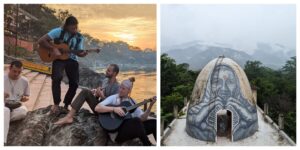
One evening, frustrated from a round of blows with the landlady, A and I planned to trek all the way to Gullu Waterfall. We made it as far as Sunset Cafe perched on a cliff several hundred metres further above our homestay and over Maggi and chai, watched the mountains turn orange while a young foreigner sat by himself, playing the guitar. That moment shared with someone I’d known barely a week and had little in common with beyond our house and our Indie girl dogs is one of the core memories I carry from the time.
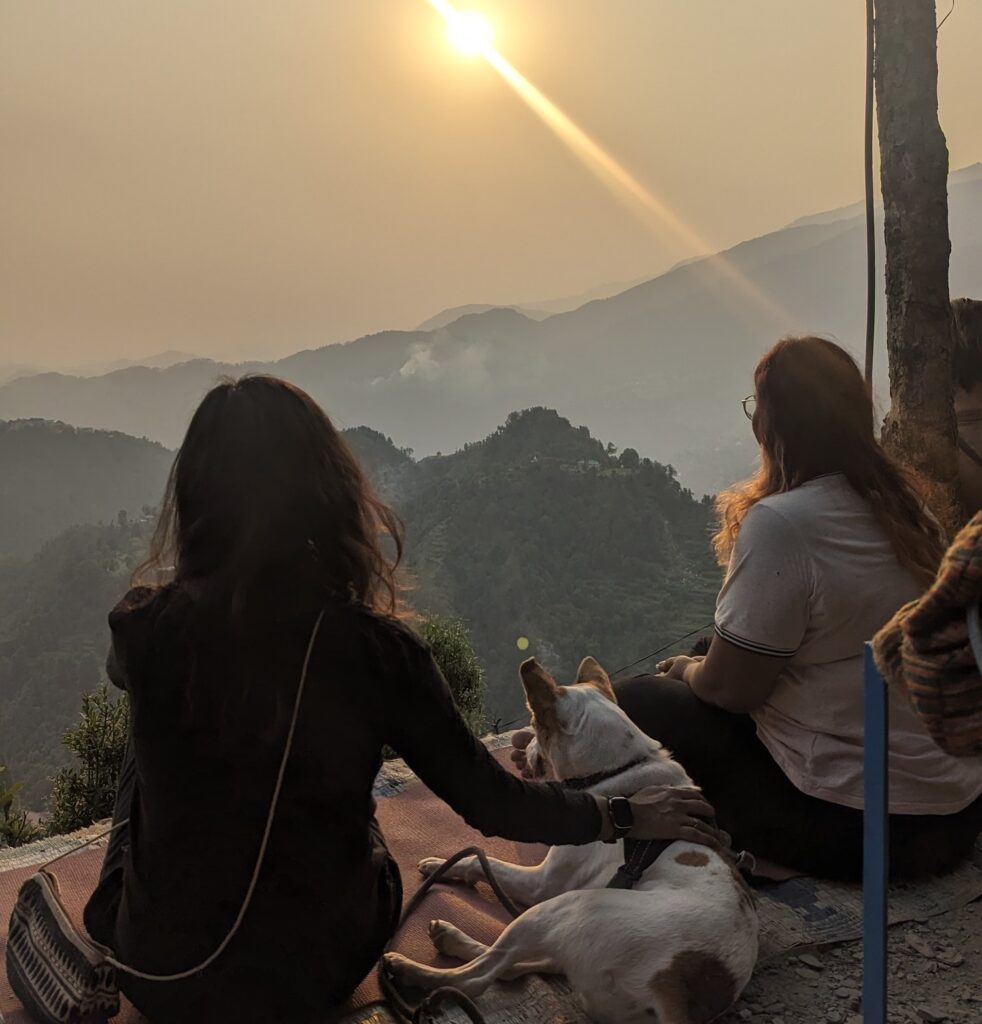
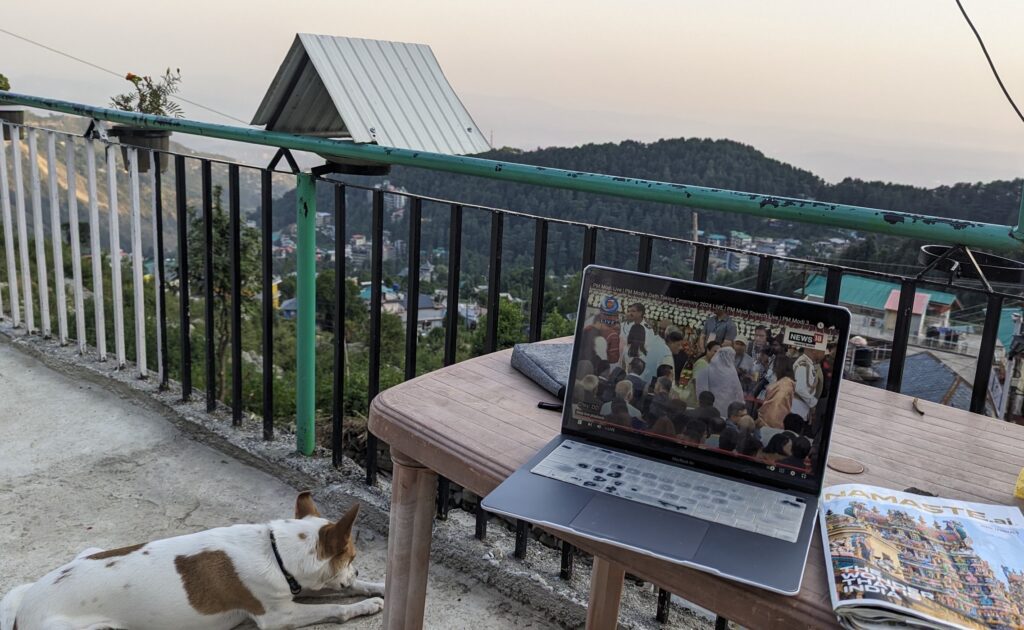
Over time, the landlady mysteriously became amenable to Peanut and me and let us stay “until alternative accommodation materialised” which as it turned out would never be needed. And I’m glad for it. Even though my digs were small and modest, I was getting comfortable there. The homestay itself was a sprawling three-storey bungalow with an old-world charm – white external walls, green iron balcony railings lined with trailing plants. Perched on one of the highest points in Dharamkot, accessible only on foot for the last hundred metres or so, it offered sweeping views in every direction. It also meant a 15-minute trek just to reach the nearest grocery store, which kept things…interesting.
But living there didn’t necessitate much going out. The lower portion of the homestay was rented by a young hospitality hustler who ran it as an Airbnb and organised social events like live gigs, cacao ceremonies, and ecstatic dances on a regular basis. Living in the house meant attending all of these for free, from my room or the wide terrace. One of my most memorable memories of this lucky arrangement is a full moon night, the sky freshly washed by an afternoon rain, with an ecstatic dance and live music that started just after sunset and carried on into the small hours. The music, the bonfire, the town lights twinkling under the imposing Himalayas in the distance and the quiet buzz of people, I soaked it all in from a comfortable distance of my room.
Dharamkot is not a place you come to with a checklist or an agenda. You come to master the art of doing nothing and just as well. I was in the middle of a career break, so a 9-to-5 had no claim on my days and it wasn’t really a workation. And yet, this month was among the most productive of my life. Even at 2100 meters, at one of the remotest points in a Himachali village, the Wifi was good! I landed a freelance marketing project soon after coming. I also wrote a significant portion of this blog from the patio of the homestay, under the watchful eyes of the mountains. But I mainly indulged in what Instagrammers would call a slow and meaningful life. I cooked most of my meals in the modestly equipped kitchen on the terrace, sometimes co-cooking with other homestay guests. Had long, unhurried breakfasts on the terrace watching the Himachal landscape do its thing. Chatted at length with the landlady, who had somewhat grown on me and surprisingly, the feeling was mutual. She was an army widow as I’d learn, still reeling from the loss of her husband, having to live in and manage this property and her two irresponsible children (who were away in other cities) all by herself. Suddenly her crankiness became relatable, not grating. On her part, after a series of Western hippies for tenants that she couldn’t talk much with, she was relieved to have an Indian guest to chat nineteen to the dozen with and who, as she put it, kept her house well and helped with the garden she’d started with so much hope. My domestic finesse had finally found its moment and somehow three women, unlikely companions in each other through their disparate lives, pains and domesticities.
Even though the homestay was affordable, but not without its limitations. The non-attached washroom was shared between three people, there was no hot water (you heated it with an immersion rod and hauled it up to the bathroom yourself), and the inaccessibility, charming in principle, could feel isolating when the action was happening just a few hundred metres downhill.
To keep myself tethered to the world, I would try to drag myself out to the busier side of the hill. I attended drop-in yoga classes every now and then. If you must do one thing in India, do yoga in Dharamkot. The combination of altitude, mountain air, and the gorgeous views of the pine-lined mountains makes it incomparable. If I were to do a yoga TTC again, I’d choose Dharamkot over Rishikesh without hesitation.
I also managed to attend a couple of early morning meditation sessions at the Tushita Meditation Centre, a centre of Buddhist studies that marks the entrance to Dharamkot with a grand yet quietly symbolic presence. It draws people from across the world and has, in many ways, put Dharamkot on the international travel map to begin with.
One weekend, I met an old acquaintance and landed up doing a day trip to the majestic 8th century rock-cut Masrur temples located about 50 kilometres away from Dharamkot. I’ve written about the highly underrated Masrur temples in detail but suffice to say, doing a drive to these nearly hidden temples through the lush, forested hills of the Himachal region, was one of the highlights of my time in the region.
Being there for over a month meant I became something of a local, I knew where the cheapest croissant or the best coffee was, having dipped heavily into the Dharamkot cafe scene. The region doesn’t have the sheer volume of the Rishikesh cafes, but equally charming with even better views from most, if slightly expensive. Sure, freshly roasted coffee and sourdough breads at 2,100 metres gotta come with a premium! So did the groceries as well as the everyday essentials. Being this remote meant online deliveries didn’t arrive at the doorstep but at a shop at the last motorable point. At some point, I also needed to haul a 10-kilo gas cylinder up a hundred steps, which made me appreciate the grit of mountain people even more.
Dharamkot was not without its icks. Beyond the ecstatic dances, the yoga, and the shanti shanti energy lurked the usual cliques, petty homestay politics, local vs outsider resentment, and occasional ‘Kalesh’ quite asynchronous with the peaceful mountain vibes. One afternoon, I had a confrontation with the owner of a nearby cafe who’d left her aggressive dog loose outside, where it attacked Peanut. Peanut bolted far away, out of sight, into unfamiliar mountain terrain with wildlife at close quarters. The next couple of hours were riddled with stress, fear, and guilt for me. “Why did I bring Peanut here! How will I face myself if something happened to her!” The search for the missing dog made it onto local WhatsApp groups. She was eventually found, unharmed, unbothered, where she was, what she did in those two hours that I almost had a stroke in, I’ll never know.
There was also a hushed debate around the Israeli presence in the area — Dharamkot has, by now, something of the character of an Israeli outpost, complete with a Chabad house and signage in Hebrew on menus and storefronts. There were also Western travelers from other parts of the world, Dharamkot being on the new hippie trail. The locals, as far as I could tell, appreciated the business but had more complicated feelings about the dynamic it created. The rapid construction around and the quickly changing nature of the small hill town however was more due to the hoardes of Indian tourists having discovered the area, than the mostly peaceful long-term Western travelers.
Just as my time in Dharamkot was drawing to a close, the last of spring was giving way to the first hints of monsoon. Fog filled the sky most of the day, mist swirled and curled over the terrace, occasional showers came and went. The place looked even more beautiful, if that was possible. My birthday fell on my penultimate day there, and I brought it in accidentally to fireworks. India had just won the 2024 T20 World Cup. Watching fireworks bloom over the hills at 2,000 metres, in a postcard-perfect hill town, is an experience I couldn’t have engineered if I’d tried.
During the day, I did the 2-hour hike to Gullu Waterfall that A and I had abandoned weeks earlier. The route was arduous and occasionally precarious, but equally stunning. The waterfall at the end, with its turquoise water, was too good not to at least wade into but since I hadn’t packed a change of clothes, any ambitions of swimming were quietly shelved. We sat by the rocks instead and let the scenery do what scenery in Dharamkot does best: make everything else feel very far away and very small.
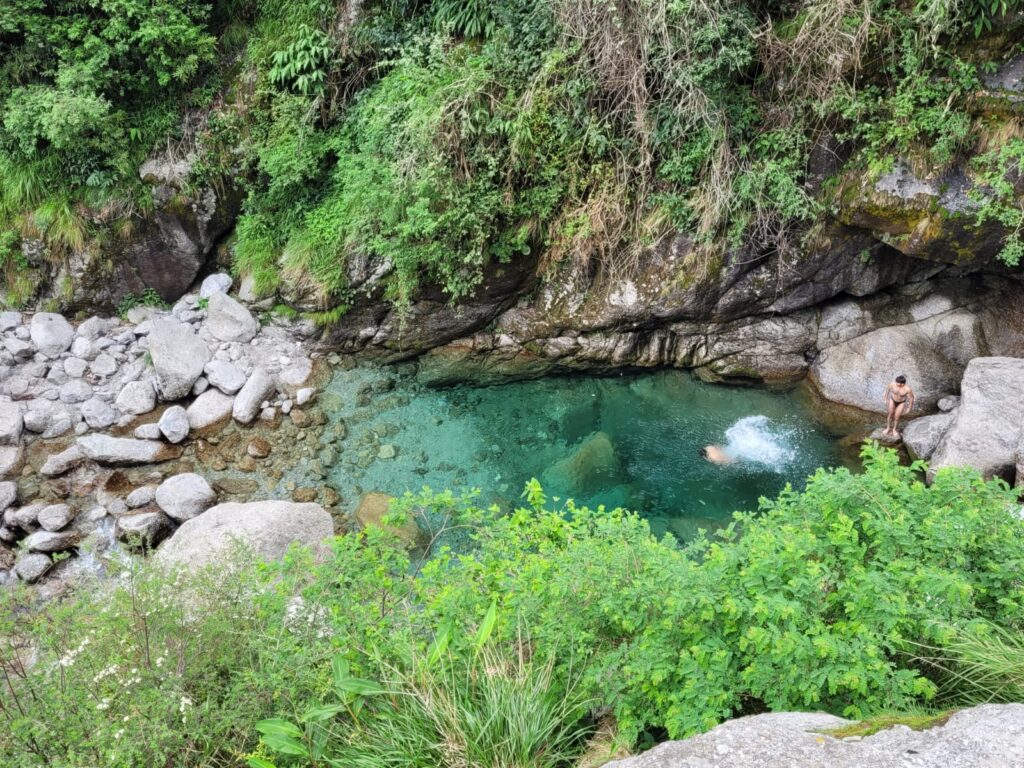
Dharamkot hadn’t only given me a respite from the scorching heat of the plains, but a taster of what a life in the hills might actually look like. Charming and calming in equal measure, but also full of challenges: some physical, some less easily named.
It also made me realise that travelling with my dog was one of the best things I’d done – for her, but equally for myself. Even though it meant jumping through more hoops than I’d bargained for, I was grateful for her companionship and quietly awed by her resilience and composure through most of it. Without her, it would have been just a holiday. With Peanut in tow, it evolved into a lesson in overcoming obstacles, negotiating with strangers, making connections over a shared cause, and seeing the world through a dog’s uncomplicated, utterly unbiased lens.