
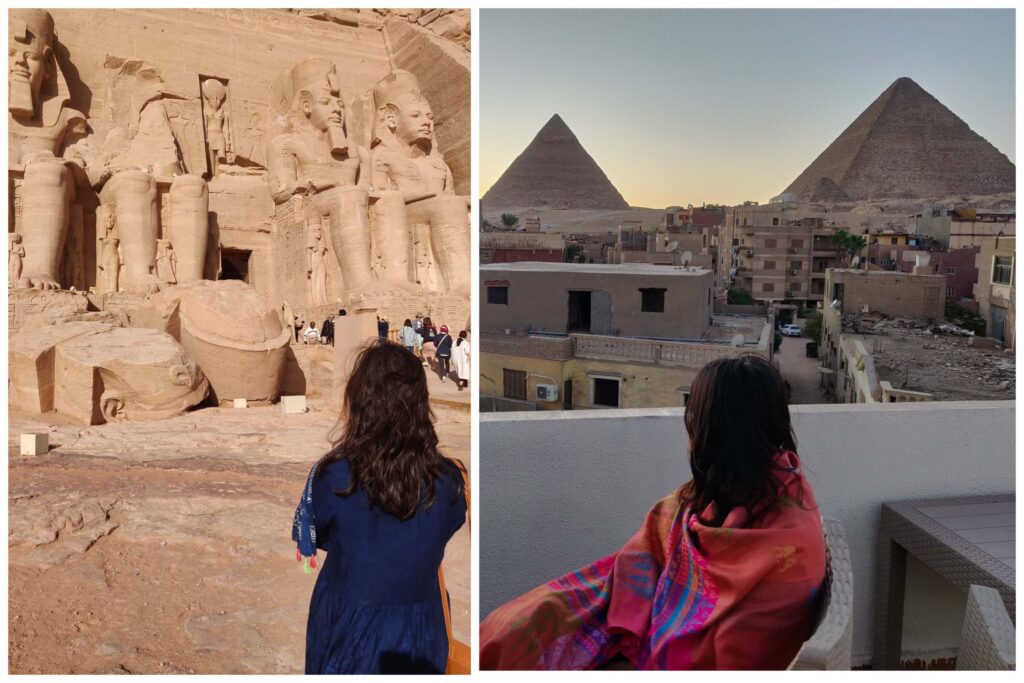
Being a huge history nerd, Egypt was always on my travel bucket list. So one nippy December evening, out of a general sense of ennui, I decided to go on a solo trip to Egypt.
Egypt is a desert country, and summers can be unbearably hot, with temperatures touching 50°C. Time, money and good weather wait for no man or woman, so I booked my tickets.
Here’s the tricky part: I decided on this trip almost at the last minute. After booking cheap tickets on Saudi Arabian Airlines (“Saudia”), I had just 7 days to get my visa.
Tourist visa for Egypt for Indians
Indians need to arrange a tourist visa in advance for Egypt and go through the whole rigmarole of documents and photos, sent through an online agency to the Egyptian consulate in Delhi or Mumbai. Within hours of booking my flight, I was scrambling to send my application by overnight express courier, the only way I could get the visa in time.
After about 5 working days, literally on the eve of my flight, I received my passport with the Egyptian visa.
Mummy, here I come! (IYKYK)
A messy beginning in Cairo
Cheap flights are fun and satisfying, but they’re cheap for a reason. After a long layover in Jeddah, dawdling for hours and watching streams of Hajj-bound passengers in their white pilgrim garb, I reached Cairo at around 10 pm. And lo and behold, Saudia hadn’t brought my luggage on this flight.
I spent ages trying to get an answer about my absent bag (and kids, this is why you don’t check in luggage!) and got none. So I decided to wait for the next Saudia flight, which arrived two hours later. My entry to Egypt was dramatic, and not in a fun way.
Around 1 am, my purple backpack finally rolled onto the conveyor belt like it was no big deal, like it hadn’t just made me spend 3 anxious hours in an airport while a Wonder of the World, under a full moon, was barely 10 km away.
Spending a night and day at Giza, in the shadow of the pyramids
It is what it is. I reached my guesthouse in Giza at around 2 am. The caretaker, Mohammed, was nowhere to be seen, but I finally found someone else (also a Mohammed) to open the door. He groggily escorted me to a room in a building where I seemed to be the only guest.
It was around 5°C that night. I had a roaring headache, I was hungry and angry, and sleep wouldn’t come. I had to wake up early to see the pyramids, for which I only had a few hours. So, sleep-deprived, I hauled myself out of bed and bathed after waiting an hour for two buckets to fill with hot water.
The pyramids could wait. First, breakfast. The silver lining of the last dreadful 24 hours was that my guesthouse overlooked the pyramids! Even before I officially visited them, I spent a good two hours staring at them over a breakfast of black tea, a leftover flight muffin and a sandwich from India.
Pyramids of Giza with many Mohammeds

Honestly, I could have stayed on the terrace and enjoyed my private session with the pyramids just as well. But you can’t fly for 20 hours and spend half your salary on a trip to see the pyramids from 1 km away. You have to be at least 100 metres away. So off I went to the official gates. The queues weren’t long, and I obediently paid a $10 entry fee to see what I could see for free.
Inside the compound, I got to whisper in the Sphinx’s ear, asking how it manages to multitask as a lion and a human when most of us can’t do even ONE of those well.
I also got close enough to touch the blocks of the pyramids. Without that sense of their shape and scale, it doesn’t really hit you how grand and perfect they are.
I walked through the sand, dodging the 100 hawkers selling everything from camel rides to private tours inside the tombs (no thanks, I’m claustrophobic) to things I can’t mention here. I was steadfast in my decision to do it alone, my way. My way turned out to be a camel ride around Giza with a guide called Mohammed. (Yes, I used to be firmly in the “camel rides are evil” camp.) I don’t know what the camel was called, but I’m pretty sure it was Mohammed too.
Once the bumpy ride was done, I trudged through the sand some more and found a vantage point to see all the pyramids in a line: the main one, Khufu, then a smaller one, then an even smaller one that forgot to pyramid.
In that moment, everything that had gone wrong in the past 24 hours stopped mattering.
Here I was, a 30-year-old single woman from India, having flown from another continent to spend a noon looking at the Great Pyramids of Giza with no one but myself. Well, until a local gentleman decided to join me.
We didn’t really chat nineteen to the dozen as he didn’t speak much English and I wasn’t known for my stellar Arabic. But he did take a few pictures of me failing massively at trying to do cool yoga asanas in front of the pyramids. (mind you, this trip was a whole 5 years before I actually a yoga course and became good enough to be a teacher. laughs in TTC)
So Mohammed and I chilled some more. I introduced him to Haldiram’s gujiya, which changed his life, and off we went (yes, from now on it was all “we”) to see what else there was to explore. (There isn’t much.)
But hunger was rising higher than the Greatest Pyramid so I went looking for my vegetarian fix in a meat country and found just the thing.
Surviving as a vegetarian in Egypt on ‘Koshari’
So, ‘Koshari’ is the national vegetarian dish of Egypt. If you’re vegetarian, just ask for Koshari and you’re sorted. It’s like rice, pasta and lentils in a spicy, salsa-like sauce, topped with fried onions and sometimes nuts. It’s delicious and filling, and it’s pretty much the only thing you’ll eat in Egypt (besides hummus) as a vegetarian.
Soon Mohammed and I were three, and we hung out at a cafe with a stunning view of the pyramids. Later, I excused myself and landed on the terrace of a neighbouring guesthouse to watch the sound and light show for free. Also free was a folksy performance by the guesthouse family, along with tons of tea.
I loved Egyptian hospitality and its endless cups of tea. Tea is a love language, and you can’t change my mind.
At around 11 pm, it was time to leave Giza for my next destination.
Overnight train from Cairo to Aswan
I took an Uber bike taxi from Giza to the Cairo railway terminal (a 30-minute ride) and boarded the overnight train to Aswan just past midnight. (Some would call it brave for a solo woman in Egypt.)
How to book trains in Egypt
Traveling by train is the cheapest and time-efficient way to get around in Egypt. Like in India, you can take a train to pretty much everywhere from major cities like Cairo, Aswan, Luxor and Alexandria. I booked my Egypt train tickets on the official site.
But unlike Indian trains, the ones in Egypt are not sleeper, a fact that I begrudged the most as I plonked myself grudgingly on a seater and remained there for the next 10 hours. But at least the tea vendors came thick and fast!
Somehow sleep did catch up with me after all, I and I woke up 13 hours later in Aswan on a sunny but pleasant noon. Outside the railway station, I got into a shared van – the cheapest way to travel locally in Egypt and got to David Hostel, my stay for the next 2 days.
Aswan is a sleepy, nondescript town, famous mainly as the starting point for trips to Abu Simbel and for Nile cruises.
I spent the day chilling at the hostel with the lovely David, its owner, and called it an early night because I had to leave for Abu Simbel at 4:30 am. (Ah, the curse of early-morning departures when sightseeing abroad!)
At 5 am, we all gathered and piled into a mini-bus on a tour organised by David. The 5-hour ride through the Sahara was so stunning that all sleep deficit was forgiven. We reached the temple around 10 am and spent a good few hours exploring.
Abu Simbel – One man’s vanity project, another million’s bucketlist
I’d seen photos, but seeing it in person blew me away. The facade of this beige rock-cut temple has not one, not two, but four identical colossal statues, all of the alpha Pharaoh Ramesses II, and all of himself.
Inside are even more statues, carvings depicting old Egyptian tales, hieroglyphics and other fascinating art.
Right next door is the temple of Nefertari, Ramesses II’s chief queen. It seems like an imitation piece next to his, but even 3,000 years ago, women got the shorter end of the stick.
The interesting thing about Abu Simbel is that it isn’t at its original location. When the Aswan High Dam threatened to flood it under Lake Nasser, the whole complex was dismantled and moved, block by block, to higher ground in the 1960s. For architecture nerds, the details of this massive operation are worth a deep dive.

Nubian Village – A burst of Sudanese culture
Next, we visited the colourful Nubian village by the Nile, set up as a tourist village. It’s painted in all sorts of colours, reminiscent of the “rainbow village” in Malang from my Indonesia trip, but with more heritage and history than a mere tourist attraction. It’s also a bazaar where you can buy handicrafts and spices, and of course lounge around with tea and sheesha.
Felucca ride on the Nile
If you’re in Egypt, you have to do a felucca ride, the traditional sailboat. The Nile, which flows north through Egypt and Sudan, is among the longest rivers in the world, and most of Egypt lies along its fertile plains, which is why the civilisation has always prospered. The sunset ride was soothing after a whirlwind two days, and the best part, of course, was the freshly made tea and sandwiches on the boat. (Tea and coffee flow like water in the Middle East!)
I got back to the hostel around 8 pm after a leisurely stroll through the local Aswan market, getting invited for tea by many charming (and sometimes creepy) locals, most of them called Mohammed, and getting a bit lost. Then I chilled with the other hostel mates in the common area. The next morning, I left for my next stop: Luxor.
Aswan to Luxor by train
Most travellers cover Egypt from north to south, but I was on a weird trajectory: land in the north (Cairo), go to the extreme south (Aswan), then retrace my way back north. The Aswan to Luxor train takes just 4 hours, and I reached around 12 noon. My hostel turned out to be shady and depressing, so I left immediately to explore.
This blogpost is getting longer than an Egyptian king’s papyrus scroll so check out part 2 covering the Luxor, Alexandria and Cairo leg of my 10-day Egypt Trip.
For a detailed breakup of the cost of my 10-day Egypt trip including flights, visa, internal buses and trains, accommodation, entrance tickets, tips, food and shopping costs, please check till the end of the part two of this.

One comment
Hi Monica! This was very helpful! I am also a solo woman who has booked her tickets to Egypt trusting I will easily procure an e-visa. However, it turns out that single travellers must do it through a travel agent only! Now I am scrambling to figure out how to find a reliable agent while still planning an itinerary on my terms! Would really appreciate if you could share the information about the travel agent that helped you out. Thanks in advance! And keep writing!