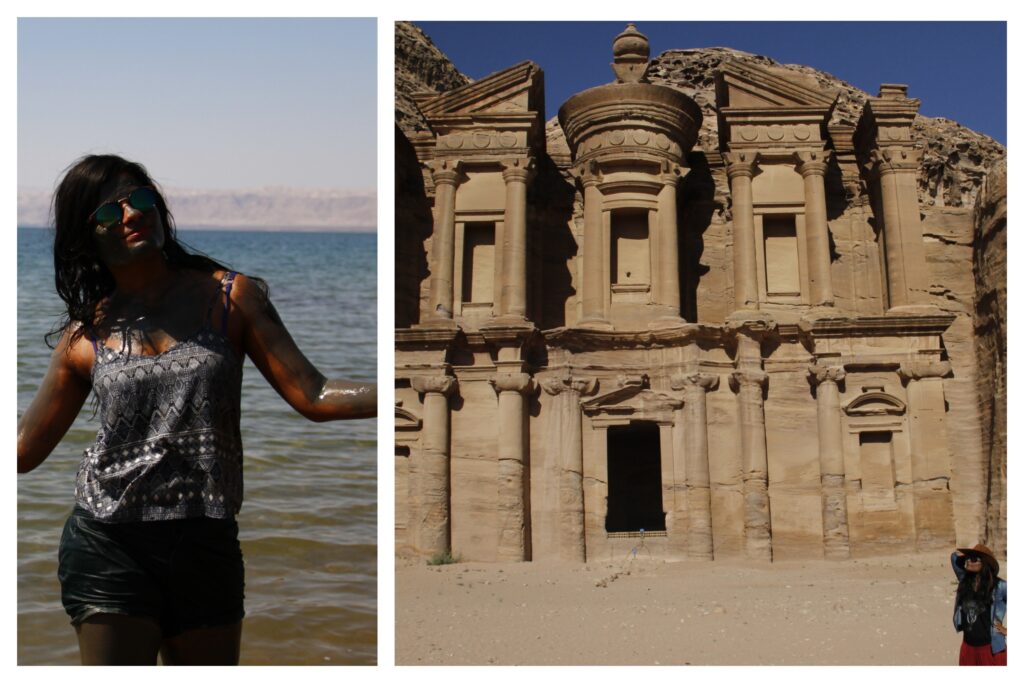
Originally written based on a trip taken in 2015. Practical information (visa, costs, Jordan Pass) updated for 2025.
We wanted somewhere within a few hours by flight, without too many visa hassles, and with a lot to see. Jordan presented itself as the obvious answer — I’d always wanted to see Petra, one of the New Seven Wonders of the World, and the country turned out to be so much more than that one headline attraction. One week, multiple deserts, a wonder of the world, a floating sea, a Bedouin campfire, and a spontaneous side trip to Israel later — Jordan remains one of the most exhilarating trips of my life.
Here’s the full itinerary, plus everything practical you need to know as an Indian traveller.
Jordan At A Glance
| Detail | Info |
|---|---|
| Trip duration | 7 days in Jordan + 2-day optional side trip to Israel |
| Best time to visit | March–May and September–November. Summers are scorching, especially in Wadi Rum and Petra. |
| Visa for Indians | Visa on arrival at Queen Alia Airport — JOD 40 (~₹8,100). Valid for 30 days. Or buy the Jordan Pass (see below) and skip the visa fee entirely. |
| Currency | Jordanian Dinar (JOD). 1 JOD ≈ ₹120. Jordan is not a cheap country — budget accordingly. |
| Getting around | Local JETT buses between cities. Taxis for shorter distances. Renting a car gives the most flexibility. |
| Jordan Pass | Buy it. Covers 40+ attractions including Petra and Wadi Rum, AND waives your visa fee if you stay 3+ nights. Starts at JOD 70. Details below. |
| Language | Arabic. English is widely spoken in tourist areas. |
| Solo female travel | Generally safe. Jordan is one of the more liberal countries in the region. Standard street-smart precautions apply. |
The 7-Day Jordan Itinerary
- Day 1: Arrive Amman — explore the city, dinner at Hashim’s
- Days 2–3: Petra — two full days at the site
- Day 4: Wadi Rum — overnight desert camp
- Day 5: Aqaba — beach, shawarma, the Gulf of Aqaba
- Day 6: Return to Amman via Karak Castle — Dead Sea swim
- Day 7: Amman — stroll, souvenirs, farewell hummus
- Optional Days 8–9: Side trip to Israel via land border
Flying From India to Jordan
Multiple airlines fly from Indian cities to Amman with one stopover — Etihad via Abu Dhabi, Air Arabia via Sharjah, Oman Air via Muscat, and Gulf Air via Bahrain are all solid options. The flight itself is about 5–6 hours plus layover. We flew Etihad with a short 2-hour layover in Abu Dhabi.
One tip: as you approach Jordan on the descent, look out of the window. The desert below is dotted with what appear to be hundreds of perfect crop circles — large circular irrigation fields that look surreal from above. It’s a strange and beautiful introduction to the country.
On arrival at Queen Alia International Airport in Amman, Indians can get a visa on arrival for JOD 40. The process is largely smooth and quick. If you’ve bought the Jordan Pass, skip the visa desk entirely — just proceed to passport control and show your pass QR code.
Day 1: Amman
We checked into our guesthouse in downtown Amman — the Mustafa Hotel, a humble two-storeyed house tucked into the bylanes of a busy market area. We were greeted with sweet mint tea, which would turn out to be one of the most enduring sensory memories of the entire trip. Mint tea, black coffee, and cigarettes: the holy trinity of Jordanian hospitality, offered everywhere, at all hours, by practically everyone.
The Roman Amphitheatre and the view over Amman
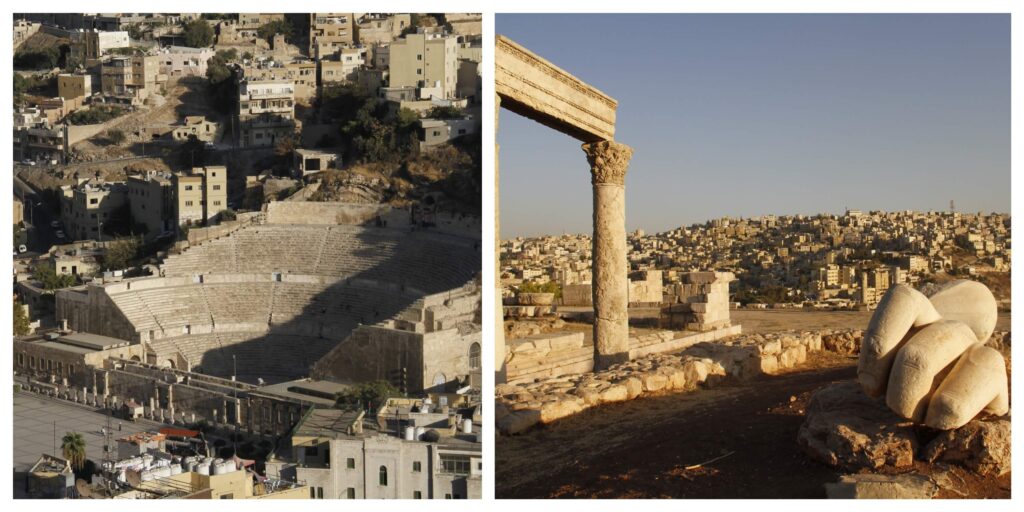
We headed out into the blaring sun to the Roman Amphitheatre — a sight of Roman ruins atop a steep hill overlooking the entire city. The trek up takes barely 10 minutes, and it’s worth every step. A Pantheon-like structure stands at the top while other ruins lie scattered around it, and from here you realise just how strikingly monochromatic Amman is — every building painted the same natural beige, the same warm stone, an entire city colour-coordinated by geology rather than design.
Dinner at Hashim’s — the best hummus of my life
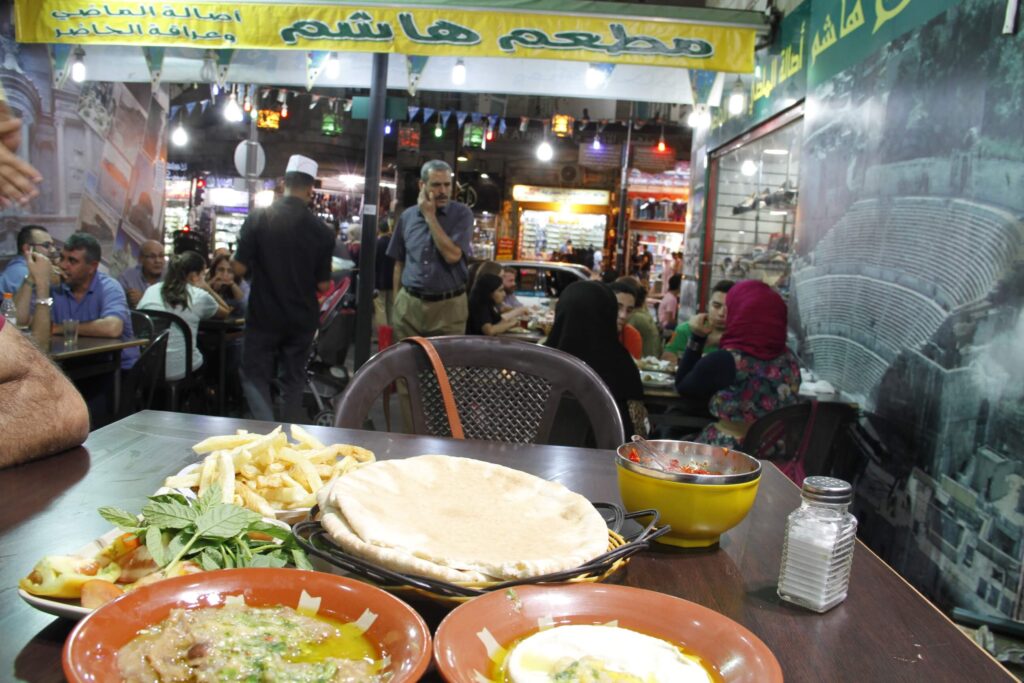
If you know me, you know hummus is something I take very seriously. Hashim’s in downtown Amman is a hole-in-the-wall eatery, completely basic in its setup, perpetually buzzing with locals. No frills, no ambience to speak of — just the most scrumptious hummus I have eaten anywhere, served with generous pita, salad, and mint tea. An evening in Amman is incomplete without dinner here. Find it, go, order everything.
Days 2–3: Petra
Established possibly as early as 312 BC as the capital of the Nabataean civilisation, Petra is the beating heart of Jordan. Famous for its rock-cut architecture — temples, tombs, and palaces carved directly into rose-red cliff faces — it was unknown to the western world until Swiss explorer Johann Ludwig Burckhardt stumbled upon it in 1812. It was crowned one of the New Seven Wonders of the World in 2007, and it earns that title.
Getting to Petra from Amman
We went independently rather than booking a tour — took a local bus to Amman’s central bus station, then another local bus to Wadi Musa (the town adjacent to Petra). The journey is under 3 hours, largely through desert highway. Our driver was cheerful, played Jordanian music the entire way, and drove with one hand while balancing a cigarette and a cup of black coffee with the other. Perfectly on brand.
We stayed at the Valentine Hotel in Wadi Musa — curiously named, but one look at the heart-shaped room number plates and the views of the gorges from the window and it made sense. Charming in a way that was more middle-eastern hipster than romantic, which suited us fine.
Petra entrance fees (2025): JOD 50 for 1 day, JOD 55 for 2 days, JOD 60 for 3 days. If you have the Jordan Pass, entry is included.
Day 2 at Petra: The Siq and The Treasury
From the ticketing area, a roughly one-hour walk through pebbled paths and gorges leads you to Petra’s main attractions. But don’t dismiss this walk as merely getting from A to B — the walk itself is part of the experience. The first 30 minutes are hot and exposed, but then you enter the Siq: a long, narrow canyon where metres and metres of brick-red stone close in on either side, leaving just a crack of sky above. Walking through it is otherworldly.
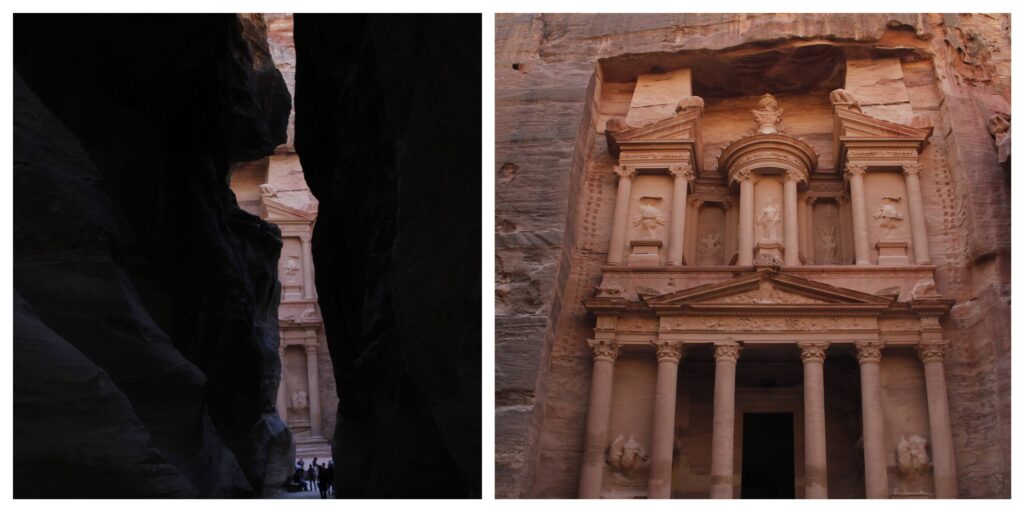
And then, at the end of the Siq, The Treasury appears.
Al-Khazneh or the Treasury is 40 metres high, eight storeys of rose-pink stone carved directly into a cliff face, with every detail of its ornate facade done by hand, in rock. The edge of the gorge frames it perfectly. Everything else — the sounds of the vendors, the camels, the other travellers — goes quiet. You just stand there. We stood there for a long time.
We spent the rest of the day wandering further into Petra, where the Siq widens and more ruins spring into view: temples, tombs, royal palaces — a whole ancient city that once housed tens of thousands of people. We saved the monastery for day two and returned to the hotel for a sunset of ridiculous beauty behind the gorges, accompanied by more mint tea.
Day 3 at Petra: The Great Monastery
We were up early and back in the Siq again — another gaze at the Treasury, still jaw-dropping the second time — and then set off for a day of serious trekking. Scattered across the heights of the Petra landscape are temples and chambers that can only be reached on foot, up steep carved stairs and along exposed ridgelines. The views from these higher points are unlike anything else — you feel genuinely transported, not just to another country, but to another era entirely.
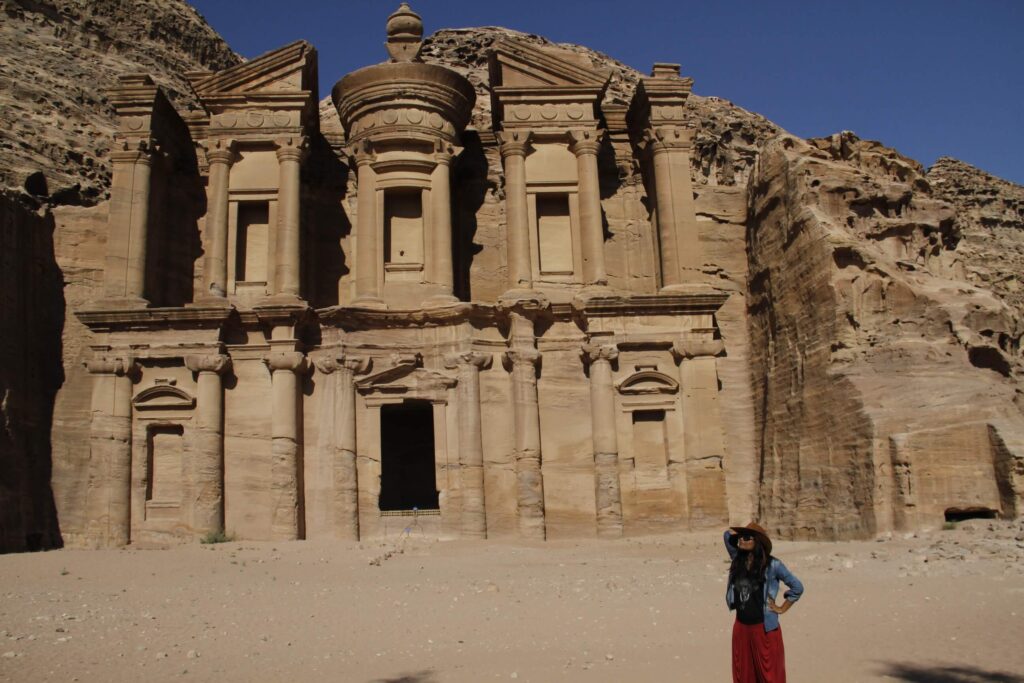
The highlight was Al-Deir: the Great Monastery. An even larger monument than the Treasury — 47 metres wide, 48 metres high — reached after a climb of roughly 800 steps. The steps are well-worn but demanding. The monastery sits at the top of a ridge with sweeping views of the valley below, and because most visitors don’t make the climb, it’s considerably quieter than the Treasury.
Back at the hotel that evening, a set-menu buffet dinner was waiting — at least 20 dishes, a generous vegetarian spread among them. We ate as people eat after a genuinely hard day of trekking, which is to say, without restraint. Went to sleep full, tired, and deeply content.
Day 4: Wadi Rum
Can a trip to the Middle East not involve the desert? After the Petra high, today was the day of Wadi Rum — the vast, otherworldly desert landscape that has doubled as Mars in more than one Hollywood film, and that looks, in person, like nothing else on earth.
We took a local bus to the entrance of Wadi Rum, where our Bedouin guide Ahmed met us. Before heading into the desert, Ahmed introduced us to the ways of the local tribe — stories of his father’s three wives, a demonstration of camel milking, and the particular unhurried warmth that characterises every Bedouin interaction I’ve had. We were loaded into an open jeep with a handful of other travellers and headed in.
Sand surfing, rock formations, and a Bedouin dinner
As the jeep pushed deeper into Wadi Rum, the landscape kept revealing itself in layers — towering sandstone cliffs, vast open plains, rock formations that jut out of nowhere and look spectacular against a clear blue sky. We stopped for sand surfing (my shoes were completely inappropriate for this, so I watched while my travel companion slid gleefully down a dune). We stopped for photos at rock formations that felt more like abstract sculpture than geology.
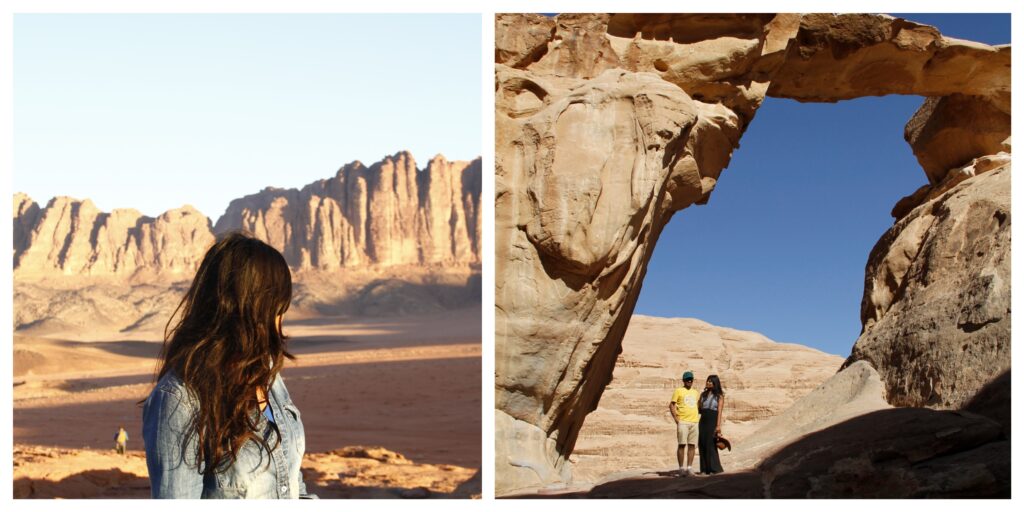
Ahmed eventually brought us to our campsite for the night — a stunning rocky patch ringed by low hills, with high mountains visible in the distance. After a short hike to catch the sunset from an elevated point, we came back down to the tent for dinner.
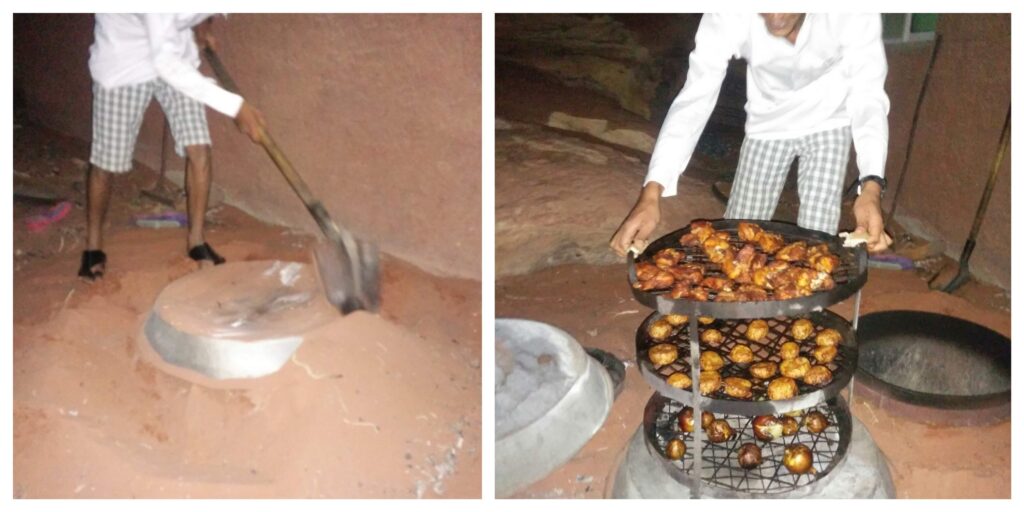
Ahmed had prepared an extraordinary spread. The centrepiece: vegetables cooked underground, buried and slow-roasted in the hot desert sand in the traditional Bedouin method called zarb. I couldn’t decide whether this or the Petra hostel buffet was the best meal of the trip, which tells you everything about how good both were. For a vegetarian finding proper, substantial, delicious cooked food abroad, it genuinely almost made me cry.
After dinner: a bonfire, hookah, and a sky so full of stars it felt excessive. Miles of desert in every direction, gorges and hills in silhouette, the sweet smell of shisha in the air. Life was very good.
Note: Wadi Rum entry and jeep tours are included with the Jordan Pass. Overnight camping is a separate cost — book through your guide or a tour desk.
Day 5: Aqaba
After a sunrise and breakfast, we drove back out of Wadi Rum and caught a cab to Aqaba — Jordan’s southernmost city, on the Gulf of Aqaba. It’s not a glamorous beach destination in the way that, say, a Mediterranean resort is. But it’s interesting for exactly that reason: it shows you a more local, unfiltered side of Jordan.
By day the city buzzes with market activity. By night, local families descend on the beach — not bikini-clad tourists, but multigenerational family groups, setting up barbecues directly on the sand, the men and women taking turns on the shisha, children running in and out of the gentle water. It’s a very particular kind of beach culture that I found far more fascinating to observe than the usual tourist-beach scene.
We grabbed dinner from street stalls — shawarmas, hummus, pita — and spent the evening with our feet in the warm water of the Gulf, watching the city do its thing.
Day 6: Karak Castle, The Dead Sea & Back to Amman
We took a local bus back to Amman, breaking the journey at Karak — an old crusader castle fort en route. By itself, the castle isn’t a showstopper, but it’s a worthwhile stop on what is otherwise a long 8-hour journey, and it adds some historical texture to the drive through Jordan’s interior.
The Dead Sea — lowest point on earth
We arrived in time to detour to the Dead Sea before reaching Amman — and this was the moment I’d been quietly most excited about since booking the trip.
The Dead Sea is the lowest point on earth, a hypersaline lake on the Jordan-Israel border with water so dense you literally cannot sink in it. The surrounding landscape — pale shore, mineral-blue water, hazy hills of the West Bank in the distance — is strange and beautiful. Most of the Jordanian coastline is claimed by resorts that charge a significant day-use fee (including beach access, a mud pack session, and lunch). We skipped all of that.
How to access the Dead Sea for free (or nearly free) on the Jordan side
This is the tip I wish more people knew about, and the one buried deepest in my original post — so I’m pulling it up here where it belongs.
- Head toward the Dead Sea highway on the Amman side, in the direction of the paid resorts (they’re clustered next to each other).
- A local bus can drop you at one of the government resorts, which charges around JOD 12 for access — significantly cheaper than the private resorts.
- Alternatively, instead of entering any resort, walk or ride about 2km back along the highway. Look for a few roadside stalls and camel riders — these mark the spot. Look downward from the highway and you’ll see one or two trail paths leading down to the water. Take one of those.
- This gives you free, direct public access to the Dead Sea. The free section is less manicured than the resorts — no showers, no changing rooms, slightly murkier shoreline — but for what you save, it’s absolutely worth it.
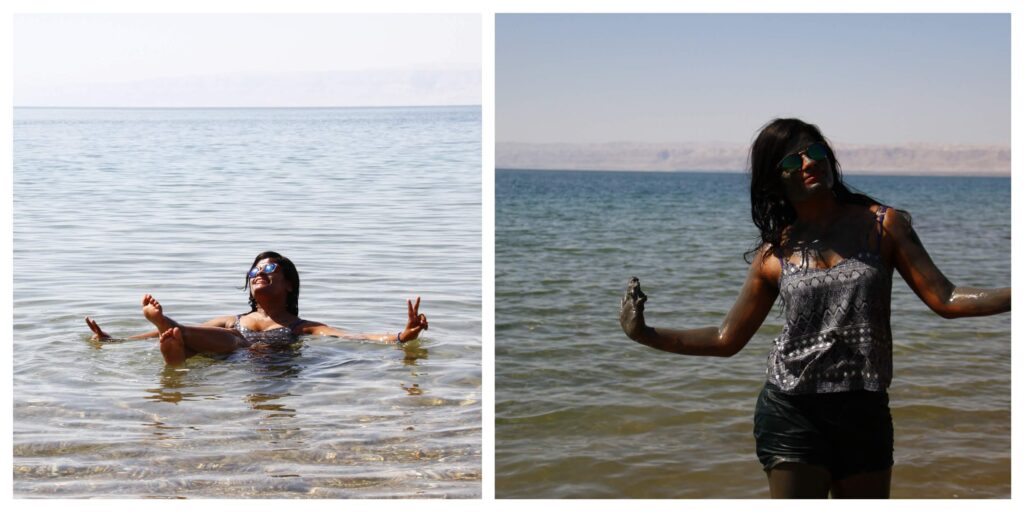
We climbed down, hesitated briefly at the shore, and jumped in. The water is a startling turquoise. And floating — just floating, without any effort, without being able to sink however hard you try — is one of those genuinely novel physical sensations that never quite gets old even after reading about it a hundred times. We floated. We scooped Dead Sea mud directly off the seabed and covered ourselves in it (the mud is said to be therapeutic; it’s certainly dramatic). We spent too long in the salty water and came out stinging pleasantly.
Day 7: Amman — Strolling, Shopping, Al Vida
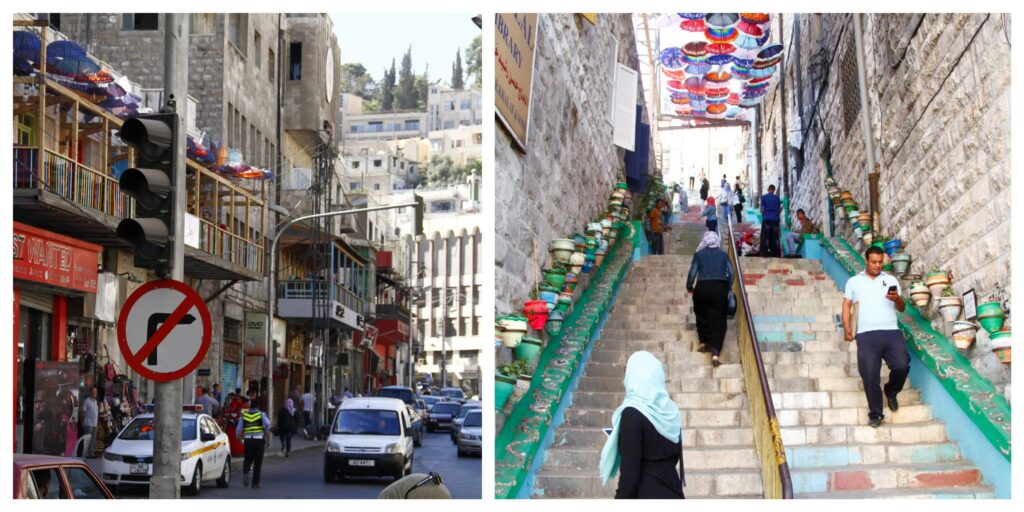
Our last day was spent wandering lanes of Amman we hadn’t explored yet, soaking in the city at a local pace. The best surprise: coming around a corner and finding a staircase completely covered in colourful hanging umbrellas — one of those unexpected, joyful urban installations that you can’t plan for but somehow remember most vividly.
Optional: The 2-Day Israel Side Trip
Israel shares a northern border with Jordan, and since we’d come all the way out to this part of the world, a detour felt too compelling to pass up. My travel companion stayed in Jordan to explore more of Amman while I crossed the border solo.
Visa note for Indians: You cannot get an Israeli visa at the border — it must be arranged in advance from India through the Israeli Embassy. The visa is issued as a separate loose-leaf sheet of paper, not stamped into your passport, which matters if you plan to visit any countries that don’t permit Israeli passport stamps.
The crossing: I left at dawn, took a shared cab to the King Hussein Bridge border crossing, paid the Jordan exit tax (around JOD 10 at land borders — note this is usually included in airfare if flying), crossed the bridge by bus, and cleared Israeli immigration in about 4 hours total including the wait. The Israeli side involves thorough security checks — more intensive than most border crossings — so start early.
I covered Jerusalem and Tel Aviv in two days. The full account of that side trip is in a separate post here: [My 2 Days in Israel from Jordan]
Jordan was one of those trips that keeps delivering surprises long after you’ve stopped expecting them. A country that would justify itself on Petra alone, and then goes ahead and throws in a desert, a floating sea, a crusader castle, and the warmest hospitality in the region. Go.