Last updated: 2025 | Based on a 23-day trip covering Austria, Hungary, Czech Republic, Slovenia, Croatia, Montenegro, North Macedonia, Bulgaria and Greece
My (then) boyfriend and I have our birthdays 18 days apart, and we were both about to turn 30. So, both being avid backpackers, we decided to bring in our 30th by finishing 30 countries. Now don’t get me wrong — we’re not country counters by nature. Both of us have spent over two decades travelling, sometimes spending a whole month in a single country, and it’s never been about ticking boxes. But a milestone birthday felt like a good excuse for a milestone trip.
We’d both done a West Europe backpacking trip before, so we knew what to expect from that side of the continent. Central and East Europe felt different — slightly rawer, significantly cheaper, and far less on the Indian traveller radar. We started in Vienna and moved steadily eastward, ending in Greece. Cities we hadn’t planned got added impromptu along the way, and we ended up covering 9 countries in 23 days. It sounds insane. It wasn’t — and I’ll show you why.

The Route At A Glance
| Days | City | Country | Nights | Highlight |
|---|---|---|---|---|
| Day 1 | Vienna (layover) | Austria | 1 | Overnight layover en route |
| Days 2–3 | Budapest | Hungary | 2 | Ruin bars, Chain Bridge, thermal baths |
| Days 4–6 | Prague | Czech Republic | 3 | Charles Bridge, Bohemian history, couchsurfing |
| Day 7 | Salzburg | Austria | 0 | Day trip — Sound of Music town, love lock bridge |
| Days 8–9 | Lake Bled | Slovenia | 1 | Emerald lake, Ojstrica viewpoint hike |
| Day 10–11 | Zagreb + Plitvice | Croatia | 2 | Museum of Breakups, UNESCO waterfalls |
| Day 12 | Dubrovnik | Croatia | 1 | Game of Thrones filming location, Adriatic coast |
| Days 13–14 | Kotor | Montenegro | 2 | Cat town, St John’s Fortress hike |
| Day 15 | Skopje | North Macedonia | 1 | Mother Teresa museum, Ottoman old town |
| Day 16 | Sofia | Bulgaria | 0 | Street art tour, Bulgarian Horo dancing |
| Days 17–18 | Athens | Greece | 2 | Acropolis, Monastiraki, Panathenaic Stadium |
| Days 19–21 | Santorini | Greece | 3 | Oia sunset, Perissa black sand beach |
| Days 22–23 | Athens → home | Greece | 1 | Parthenon, birthday dinner, farewell ouzo |
Here’s our 23-Day Itinerary for our Central and East Europe Trip from India
Day 1 Flew into Vienna and had an overnight layover
We flew from New Delhi to Vienna with a 12-hour layover in Kiev, Ukraine. I’m not counting Austria in my count because of Vienna because we just spent about a night and some of it in the day from the bus, but because we spent a whole day in Salzburg later which also is in Austria.
Day 2 – Ruin Bars, Thermal Baths & Bringing In The 30th in Budapest
A 4-hour Flixbus from Vienna got us to Budapest around noon. First impression: as beautiful as they come — like Paris on a budget, but with better dive bars and a more interesting history. Our hotel near the famous Liszt Ferenc Square put us right in the thick of things.
(Little did I know that 4 years later, I’d be back in the city for a company retreat and walking the same streets.)

We immediately joined a guided walking tour — the best first-day investment in any new city — which took us past the State Opera House, the Great Synagogue (one of the largest in the world), the Academy of Music, and the iconic Hungarian Parliament building sitting majestically by the Danube. We didn’t make it far past a local beer festival, however, which seemed like a more pressing cultural experience at the time.
In the evening we headed to Szimpla Kert — Budapest’s most famous ruin bar — a multi-level, gloriously chaotic bohemian space decorated with everything from old bathtubs to vintage bicycles. Budapest has hundreds of these ruin bars, tucked into alleyways within alleyways, and 1-euro beers are not a myth. The city is a legitimate party destination and deserves more than 2 days if you have them.
Day 3: Sightseeing in Budapest and bringing in M’s 30th!
Day 3 was for sightseeing properly. Széchenyi Bath — one of Budapest’s famous thermal bath houses — is a must-see even if you don’t get into the water (we couldn’t, for reasons I can no longer remember). The sight of hundreds of people splashing about in sprawling blue thermal pools inside a sunshine-yellow baroque palace is quite something. Spa parties — Sparties — are apparently a thing here on weekend nights.
We paid our respects at Heroes’ Square, commemorating key figures of Hungarian history, picnicked in City Park (which would become a recurring habit on this trip), and walked up Castle Hill for panoramic views of the Pest side of the city. Don’t miss the ancient fountain with the kings and their dogs — and the Buda Castle at night, romantically lit, with a lone violinist providing the soundtrack.
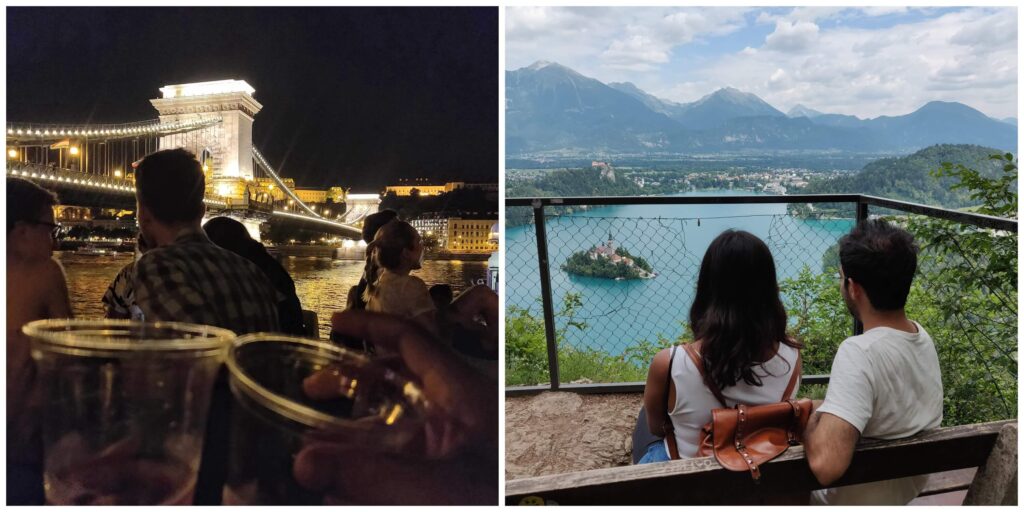
We ended the evening at the foot of the Chain Bridge with a pizza and a bottle of red wine, looking up at the dazzling Budapest skyline. 30 years old. Not a bad way to mark it.
Day 4-6 – Prague, Czech Republic — Bohemian History, Charles Bridge & Couchsurfing
Prague was a few hours by bus from Budapest and was the only city where we couchsurfed instead of booking accommodation. Our host was the lovely Zuzanna, who welcomed us into her small, characterful boho apartment on the outskirts of the city. Getting there from the centre took some time, but the warmth and the genuine local experience more than compensated.
Day 4 was a wash — traffic delays meant we arrived late, and I was starting to come down with something, so we called it early and spent the evening on Zuzanna’s couch just chatting with her gracious host. No regrets.
Day 5 – Exploring Prague’s bohemian and Nazi history on a rainy day
Day 5 was Prague’s Bohemian and darker history. Despite grey skies and a slight fever, we joined a walking tour through the historic old district — past Wenceslas Square, the astronomical clock, the site of the WWII Prague uprising, and finally the Charles Bridge: a 600-year-old medieval stone arch bridge lined with 30 statues leading to a gothic castle. We ate pizza by the bridge at night with the city glowing behind us, which is one of those travel memories that stays.

On our way back, we stopped by for a quick look at the ‘Dancing Building”, and came back to eat a pizza by the Charles bridge with stunning views of Prague by night.

Day 6 – Letna Park, Chimney Cakes and beer guzzling in Prague
Day 6 — both under the weather and thoroughly comfortable in Zuzanna’s apartment — we started late, made it to Letna Park for a hilltop picnic overlooking old Prague and the Vltava river, got beers from the park cafe, found WiFi, and called it a productive afternoon. We took Zuzanna for a vegetarian Indian meal that evening as a thank-you, then said our farewells early the next morning for the train to Salzburg.
Day 7 – Salzburg, Austria — Mozart, The Sound of Music & A Love Lock Bridge
We weren’t staying overnight in Salzburg — left luggage in the station lockers and spent a full day on foot. Salzburg is small enough to walk entirely in a couple of hours, which is both its charm and its limitation.
We started at the Mirabelle Gardens — sprawling baroque gardens with manicured greenery, elaborate fountains, and the kind of symmetry that makes you understand why this city keeps appearing in films. Then through the Cathedral area, past a strikingly beautiful medieval cemetery, and along the colourful buildings that appear to be carved directly into the cliff face.

In fact at some point, we didn’t know what to do so we sat around the steps of the square and witnessed a Vegan Campaign with volunteers wearing Guy Fawkes masks holding laptops and showing animal cruelty involved in the meat industry. Back then, I wasn’t a vegan yet, but I remember this event having some subconscious impact on me.
Around sunset, we crossed the pedestrian only “love lock bridge” with a beautiful sunset and a street musician’s haunting score in the background! On the other side of the river, Salzburg looked like that postcard perfect European hamlet with its mountains, medieval buildings and the fortress forming a backdrop to its charming houses, cafes and squares. Salzburg turned out to be the perfect little day trip. Not sure if we would’ve got a lot more from staying overnight and spending another day so a day in Salzburg was just about enough.
Day 8 & 9- Lake Bled, Slovenia — Emerald Water, Viewpoint Hikes & A Bollywood Fan
We took a semi-overnight bus from Salzburg, arriving in Bled in the early morning. The journey was what I’d always imagined Switzerland to look like — lush green meadows, snow-capped Alps, quaint cottages — with a stop at a roadside place that felt, unexpectedly, like a dhaba back home, except without the chai.
Our hotel receptionist in Bled had seen the Bollywood movie 3 Idiots (A movie in which I, incidentally happen to have a 1-second ‘role’ in!) In a town the size of Koramangla, in a country most Indians couldn’t find on a map. This is why I love travelling — these small moments of joy and connection outweigh even the most spectacular sights.
We spent day 8 gently — a walk around the lake, some dog-petting, a long lounge on the green lawns by the water with no particular agenda.

Day 9 – Hiking for stunning views of lake Bled
Day 9 was for the hike. We packed pizza slices and coffee, walked to the lake, and trekked up Ojstrica — a viewpoint offering one of the most beautiful vistas I’ve seen anywhere: the town of Bled, the impossibly green lake, the tiny island with its church, and the surrounding mountains, all at once. We ate our pizza at the top. This carry-pizza-eat-at-a-viewpoint system was now an official trip policy.

We got back to the lake by 4pm, and soon it was time to leave. After a brief stopover in Ljubljana, Slovenia’s capital and an extremely tricky word to spell and pronounce, we were on our way to Zagreb, Croatia’s capital, checking off country #5. Little did I know that 4 years later, Slovenia would become such an important part of my life. (More on that later.)
Days 10–11: Zagreb & Plitvice Lakes, Croatia — Lavender, Football & UNESCO Waterfalls
I’d be honest, by the time we got to Zagreb, Europe fatigue was setting in and capital cities were starting to blur. But Zagreb had a few things that cut through. The walking tour included the Museum of Breakups — a deeply Croatian idea, a museum of objects and memorabilia from ended relationships across Europe — which we admired from the outside (we didn’t go in, in case anyone got ideas). Croatia is also the lavender capital of Europe, and the markets are full of fresh and dried buds, potpourri, and lavender everything. I bought some. Smelled great for the rest of the trip.

The Football World Cup was on during our visit, and Croatia, being a significant football nation, was electric. We sat at Ban Jelačić Square and watched a match on the big screen with takeaway pizza and a crowd of extremely passionate Croatians. Highly recommended as a cultural experience.
Day 11 – Plitvice National Park, Croatia
Day 11 was a day trip to Plitvice Lakes National Park — a UNESCO World Heritage Site and one of the most genuinely beautiful places I’ve been in Europe. Embedded in a mosaic of forests and meadows, Plitvice Lakes National Park conserves a strikingly beautiful and intact series of lakes formed by natural tufa barriers. Even though it was an expensive entry ticket (Around $25), the park was beautiful, with emerald green tall and cascading waterfalls everywhere the eye looked!

We were done at the park by 5pm and headed back to Zagreb, caught another football match at the Ban Jelačić square, and chitchatted with an elderly solo traveler in our hotel.
Day 12- Dubrovnik, Croatia — Game Of Thrones & The Adriatic
An early morning bus south to Dubrovnik — a coastal medieval city and one of the most visually striking places on this entire trip. We’re both Game of Thrones fans, and Dubrovnik is King’s Landing, which gave the place an additional layer of surreal recognition.
We stayed with a lovely Croatian family in an Airbnb within the old town — welcomed with a sweet drink and cake, which set the tone perfectly. Dubrovnik has an electric, slightly theatrical energy: medieval walls, Adriatic blue peeking around every corner, and cafes that charge accordingly for the view. We walked the famous Walk of Shame filming spot (GoT fans will know), explored the forts and squares, and had dinner at one of the many plaza cafes rather than the Michelin star restaurant we briefly considered and sensibly abandoned.

Days 13–14: Kotor, Montenegro — The Town of Cats & A Fortress With A View
Montenegro wasn’t originally on the itinerary — it appeared because the road from Dubrovnik to Greece required passing through it, and once we looked it up, there was no question of passing through without stopping. This impromptu addition turned out to be one of the trip highlights.
Getting there involved a strict border check at Albania and — memorably — our bus driving aboard a cruise ship to cross a channel. This is the kind of thing that happens in the Balkans and I love it.
Kotor is a small medieval walled town (population ~15,000) on the Bay of Kotor, and it is as charming as small medieval walled towns get. Modern waterfront cafes lined by well-preserved medieval churches and squares. And cats. So many cats. One around every corner, under every bench, in every souvenir shop. Most Montenegrin souvenirs feature a cat. The cats are not incidental — they are the culture.

Day 14 – Hike up to St John’s fortress for stunning views of Kotor Bay
Day 14 we hiked up to St John’s Fortress — an easy 2-hour climb with views at the top that made us forget we were slightly tired and slightly sunburnt. The mountains close in around the bay below, making Kotor look like a hidden secret from the world. We came back down, did our ritual supermarket browse (Montenegro: cheapest country on the trip, confirmed by the Nutella Index), ate spanakopita from a bakery for lunch, and got a late evening bus to Podgorica for an onward connection to Skopje.

Day 15 – Skopje, North Macedonia — Mother Teresa, Statues & Ottoman Old Town
We arrived in Skopje at 5am and were grateful for an early hostel check-in. Skopje, I’ll be honest, left me underwhelmed — though Europe fatigue was real by this point and may have coloured my experience. The city centre is dominated by statues — hundreds of them — part of a controversial and expensive 2014 reconstruction project that added fountains, neoclassical buildings, and statues to what had been a fairly austere post-communist cityscape. The effect is ambitious if slightly chaotic.
The standout: Mother Teresa’s museum. She was born in Skopje, and the museum houses her letters to the nuns back home among other artefacts. Worth a visit for the history alone.
The Ottoman old town was the part of Skopje that felt most genuinely itself — a large Muslim population, local markets that reminded me of Hyderabad’s old city, the kind of authentic urban texture that no reconstruction project can manufacture. We were glad not to be spending longer in Skopje, took a local bus to Sofia the next morning.

Day 16 – Sofia, Bulgaria — Street Art, Byzantine Domes & The Horo
We left our luggage at Sofia central station — this was a transit stop with no overnight stay — and spent a full day in the city. Sofia surprised us. After Skopje, we were braced for more post-communist flatness, but Sofia has considerably more character.
We did the self-guided Sofia graffiti tour — a well-documented route through the city’s street art districts, where advanced wall murals cover the grey Soviet-era buildings with colour and commentary. The city supports its street artists and it shows.

Post the arty districts, we used the imposing statue of Sofia saint to orient ourselves, got a takeaway pizza from a local deli, and plonked ourselves at a Borisova garden, a large public park to enjoy a little picnic. While Skopje left us underwhelmed, Sofia, despite a very similar historical background, turned out to have a lot more character. The presence of well-preserved architecture from its Byzantine and Ottoman days was clearly visible in historic buildings like the Roman Rotunda, the Sveti Sedmochislenitsi Church, an Ottoman Church was which once a mosque, just like the Hagia Sofia (from my 3-day Istanbul trip), and the Alexander Nevsky Cathedral, a humungous green-domed building.

At the city park, we witnessed a group of locals doing the “Horo”, the national dance of Bulgaria, while dressed in traditional costume, and at some point, got pulled into the dancing which was surprisingly a lot of fun and probably the most authentically local experience I’d had so far!
Sofia was cheap, and a nice place for a day or two. But again, it’s a capital city, and there isn’t a whole lot to do or see for longer. Finally at midnight, we had our first inter-Europe flight of this trip to get to our final destination, Greece.
Days 17–18: Athens, Greece — The Acropolis, Democracy & A Marathon Cruise
Greece. The country I was most excited about. The birthplace of democracy, of philosophy, of Socrates and Plato and the Greek gods, both literally and otherwise. We landed at 10am, and the city immediately felt different — warmer, more ancient, heavier with history in the best possible way.
A random traveller on the way out of the airport handed us his remaining metro passes. Athens: off to a good start.
After spending the scorching hot noon in our Airbnb, later in the evening, we joined an evening walking tour — starting at the Greek Parliament for the mesmerising Change of Guard ceremony at Syntagma Square, then to the Panathenaic Stadium: white marble, built 2,000 years ago, abandoned and revived, venue of the first modern Olympics in 1896. The tour ended on a hill with the glittering Parthenon on the Acropolis as the backdrop. We saved the Acropolis itself for the last day.
The Monastiraki area — cobblestoned pedestrian lanes, open-air cafes, souvenir shops, and constant views of the Parthenon — is where Athens’s traveller life happens. Eat here, drink here, walk here at all hours.
Day 18 – Cruise to Santorini and checking into the most charming Airbnb in Perissa
Early in the morning, we got to the Piraeus port in Athens and booked ourselves a public cruise to Santorini — a 6-hour crossing on the choppy Aegean, passing the islands of Naxos and Paros. Worth every wave
Since it was peak season, we had to contend with an Airbnb located in Perissa, a coastal village, far from the visuals that Santorini is synonymous with.

But to our surprise, our Airbnb turned out to be charming property with bougainvilleas trees in the patio and an in-house swimming pool.
The Perissa beach, walking distance from our Airbnb, turned out to be a wonderful revelation as the black sand beach framed by volcanic mountains and charming churches in the distance was a great option to spend a calm evening after a tiring day on the ship. Picking up a $5 bottle of locally produced red wine from a supermarket, we plonked ourselves on sun beds on the black beach and had ourselves a lil private party.
Days 19–20: Santorini, Greece — Sunsets, Black Sand & The Blue Dome Queue
Next day, after a little inhouse breakfast in the patio of our Airbnb, we took a local bus (1,18 hours) from Perissa to Oia. The first thing that hit us about Oia was just how crowded and buzzing it was! Even before we saw the seaside, we had to wade through the sea of tourists all around. Backpackers, vacationers, honeymooners, digital nomads, locals, and everything in between. We saved the popular spots for the next day and took a less-trodden path by the cliffside to get to the sunset point. On the way, we passed the famous Blue domed church, THE most prominent sight in Santorini, but as expected there were selfie queues and you could wait up to 30 minutes to get to take your click and even then you’d barely have a minute to get that money shot, before next contenders start tut-tutting you to move!

If the rest of the trip was easy-paced and chill, Santorini brought out the claws! By the time we made it to the Sunset point, the sun was well set so we beat it to beat the crowds again to make it back. We didn’t want to miss the last bus from Oia to Perissa so just to be on the safe side we took the one at 8pm and got back to Perissa beach, and finally breathed! After the madness of Oia, Perissa felt like a calm, almost a private haven.
Day 20 – Final shot at Oia to catch the famous Santorini sunset
Next day, we were back to Oia for another outing. Having got a bit familiar with Oia now, we walked around leisurely though the narrow levelled allies, full of cafes, arty boutiques and souvenir store. (everything is expensive!) Picking up Gyros at the famous ‘Suvlaki’s, we started to retrace yesterday’s steps, and this time, managed to get a few pictures at the Blue Domed Church and a few other famous spots. At around, we were at the sunset point, as were a 1000 others, everyone waiting with baited breath for the showdown. And yes, the sunset was every bit as spectacular as it’s made out to be. As the sun went down, the entire white-topped cliff village went white to pink to sepia, the crowds went different levels of “oooooh”, we leisurely devoured our Gyros, and the music from the street artists lent the perfect background score for the romantic visuals. It’s not hard to see why Santorini is as hyped as it is, though one can’t help but wonder, if other Greek islands of Naxos and Paros may just be few white-washed cliff-side houses away from a Santorini-like reckoning.

Post the scramble of Oia, we took the overnight cruise back to Athens, sleeping in chairs inside rather than on the deck (we’d skipped booking a cabin — not recommended). Athens at 4am. Final stretch.
Days 22: Athens — The Parthenon, 30th Birthday & Farewell Ouzo
Sleep-deprived and happy. Day 22 was slow — a balcony breakfast of store-bought hummus, local bread, and black coffee in our studio apartment in a residential district away from the tourist centre. Then finally, properly, the Parthenon.
A 2,500-year-old temple, which has survived multiple civilisations, conquests, natural calamities, wars, and the Ottomans using it as a gunpowder magazine (it exploded in 1687 — and still stood). It is permanently under restoration, so one or more sides will usually be under scaffolding, which slightly tempers the visual but can’t diminish what it represents. Standing on the Acropolis looking out over Athens, it’s not hard to understand why Western civilisation considers this its birthplace.

Final dinner: a rooftop cafe in Monastiraki with the Parthenon glowing above us, ouzo, moussaka, and a birthday eclair hastily bought at midnight because we’d forgotten to get an actual cake.
30 years old, 30 countries, 23 days. Done.

Day 23 – Bidding bye to Europe for now, and a 12-hour Singapore layover
The next day, our host dropped us to the Airport bus stop, and taking the same Airport bus to the Athens Airport, we flew back to India, with a 10-hour layover in Singapore giving us enough time to get out in the city. M managed to do his 32nd country just like that while for me, it was reliving my 2007 Singapore college trip all over again!
Day 24 – Back to homeland
After 24 complete days gallivanting in Europe, hopping countries like hopping cafes back home, we were back to India, having now successfully completed our 30th country by 30, and then some.
Are 3 weeks in Europe enough? Was my trip too rushed?
I know to anyone reading, especially slow travelers from Western countries, this would sound like a “rushed” trip. I hear you. If I had the luxury of unlimited time off, a remote job (back then), and/or a passport that didn’t require a limited-period visa at most destinations, I’d spend weeks and months exploring a single country myself too, like I my two week Japan trip, Australia, Turkey, and Egypt.
But to be honest, to me, the days and time I did spend on each place in this trip felt enough. I didn’t feel I needed more time anywhere. After you’ve done 5 European cities, Europe fatigue gets real and places start blurring. I don’t think any two places in East Europe can be that wildly different that you need a week in each.
So to me, my three-week trip covering these 12 odd cities gave me a good glimpse of the city, if not the 100% immersion I’d have otherwise liked.
Costs of a 3-week Eastern Europe trip from India
This 22-day~ trip to Central and East Europe trip covering 9 countries cost us about Rs. 1,50,000 (or around $2000) each.
25% of this cost was the New Delhi to Vienna and Athens To Bangalore inter-continental flights which we’d booked 3 months in advance. The rest of the costs were distributed between the inter-country buses/trains in Europe, accommodation at an average of around $15/per night per person, food at around $10 person per day, and the remaining was entrance tickets, tips on walking tours, currency exchange losses, visas and shopping.
A hack to saving money on Europe trip like this would be to:
- Take overnight buses between cities — you save a night’s accommodation and wake up at your next destination. Works especially well for longer legs like Zagreb to Dubrovnik or Kotor to Skopje.
- Eat from supermarkets — hummus, salads, bread, cheese, local yoghurt. Eastern European supermarkets are brilliant and cheap. We used the Nutella jar as our budget index across countries — Montenegro won.
- Pizza by the slice + a viewpoint — this became our signature move. Pack two slices from a local place, hike to a viewpoint, eat with the best view in the city. Infinitely better than a restaurant meal.
- Free walking tours — available in almost every city on this route. Tip-based, guide-led, and the best way to orient yourself on day one. We did them in Budapest, Prague, Athens, and Zagreb.
- Book Flixbus early — prices increase as dates approach, just like flights. Book intercity buses at least a week in advance.
- Couchsurfing — beyond the free accommodation, the genuine local experience is irreplaceable. Our Prague host Zuzanna enriched the whole Czech leg of the trip.
- Plan for full days in each city — two half-days in a city (arriving late, leaving early) means two nights of accommodation for minimal exploration. Structure your itinerary so you’re arriving and departing at efficient times.
Frequently Asked Questions
Practical Information For Indian Travellers
Schengen Visa
This is the big one. Most countries on this itinerary — Austria, Hungary, Czech Republic, Slovenia, Croatia, Greece — require a Schengen visa for Indian passport holders. Montenegro and North Macedonia are non-Schengen but generally allow Indians on a valid Schengen visa or issue their own visa on arrival or at the border — verify current rules before travel as these change.
Key things to know about the Schengen visa for this trip:
- Apply at the embassy of the country where you’ll spend the most time, or your first entry point if time is roughly equal. For this itinerary, Greece or Austria would be the typical application point.
- Apply at least 6–8 weeks before travel. The process involves an in-person appointment, bank statements, itinerary, hotel bookings, travel insurance, and pay slips.
- A Schengen visa allows 90 days within a 180-day period across all Schengen countries.
- Travel insurance covering the full Schengen zone is mandatory for the application and genuinely useful to have.
Flights
We flew New Delhi to Vienna with a 12-hour layover in Kyiv. Book intercontinental flights at least 3 months in advance for the best prices. Return or onward flights from Athens (or whichever is your exit point) tend to be cheaper than open-jaw tickets, so factor that into your planning. We had a 10-hour Singapore layover on the way back which gave us a bonus half-day in the city.
Getting Around Within Europe
We used Flixbus for almost every intercity journey — it’s reliable, reasonably comfortable, and covers virtually every city on this route. Book a few days in advance as prices increase significantly closer to the date. We took only one train on the entire trip (Prague to Salzburg). Overnight buses save you a night’s accommodation and are worth it on longer legs.
Accommodation
A mix of budget hotels, hostels, Airbnbs, and couchsurfing — averaging around $15/night per person. Prague was our only Couchsurfing stop, courtesy of the lovely Zuzanna. Airbnb worked particularly well in Santorini where the local family stays have more character than any hotel.
Budget Summary
| Cost Item | Approximate Cost (per person) |
|---|---|
| Intercontinental flights (Delhi–Vienna + Athens–Bangalore) | ₹35,000–40,000 |
| Intercity buses within Europe (Flixbus etc.) | ₹8,000–12,000 |
| Accommodation (avg $15/night × 22 nights) | ₹25,000–30,000 |
| Food ($10/day × 23 days) | ₹17,000–20,000 |
| Entry tickets, tips, walking tours | ₹8,000–10,000 |
| Schengen visa + travel insurance | ₹8,000–10,000 |
| Currency exchange losses, miscellaneous | ₹5,000–7,000 |
| Total (approximate) | ₹1,10,000–1,50,000 |
Our actual spend was around ₹1,50,000 (~$2,000) each for the full 23 days. East Europe is significantly cheaper than West Europe — Hungary, North Macedonia, Montenegro, and Bulgaria in particular are excellent value.
After 24 days gallivanting across Central and East Europe, hopping countries like hopping cafes back home, we lande in India having completed our 30th country by 30. The trip was many things — occasionally exhausting, sometimes sick, always fed, perpetually amazed. East Europe does something to you. It gets under the skin in a way the glossier parts of the continent don’t quite manage. Go.